English



Government Agencies
Strategic Advisors to Permanent Commission on Access to Justice
Neil Steinkamp and Samantha DiDomenico recently contributed to the book, “Rethinking the Lawyers’ Monopoly: Access to Justice and the Future of Legal Services.” They have co-authored a chapter that offers an innovative framework blending financial analysis, stakeholder engagement, and program evaluation to expand access to civil justice.
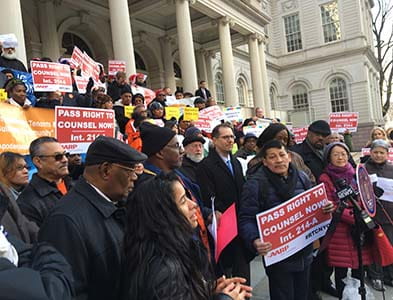
Drawing on their experience working in more than 40 jurisdictions across the country, they highlight how combining rigorous cost-benefit analyses with community voices equips policymakers and advocates to design reforms that are practical, sustainable, and rooted in local experiences. Their evaluations of eviction right to counsel programs in Chicago, Cleveland, Connecticut, Maryland, Milwaukee, Nashville, and Oklahoma demonstrate how pairing quantitative and qualitative analysis and research results in a nuanced understanding of how reform impacts communities and systems.
Beyond housing, Steinkamp and DiDomenico have advised courts, bar associations, and non-profits on civil justice initiatives ranging from support for self-represented litigants to non-profit budget sustainability, data-driven program evaluations, and stakeholder engagement. These projects have contributed to landmark legislation, improved delivery of legal services, and created measurable returns on investment for state and local governments.
The co-authored chapter is available via this link at the Cambridge University Press website.
“[Transformative change occurs] when there is an emphasis on incremental progress, acknowledging that no singular policy can comprehensively address all aspects of complex social and justice issues.”
“By engaging a range of local stakeholders, listening to their perspectives, leveraging and reconciling academic scholarship, collecting and integrating quantitative and qualitative information, and seeking regular feedback as analysis and observations are developed, cost-benefit analyses form the basis for collaboration that can lead to issue convergence in support of expansion of access to civil justice.”
“Intentional inclusive stakeholder engagement creates the opportunity to continually learn about the ecosystem and to create collaborative environment that establishes or renews connections among stakeholders.”
“Civil access-to-justice reform pursued through a financially focused, stakeholder-informed approach can drive transformational change. We present a framework and set of techniques, which together we dub 'civil justice engineering,' for developing effective, scalable policy and procedure for the expansion of civil access to justice informed by qualitative and quantitative data, financial analysis, program evaluation, and stakeholder engagement.”
“This work needs to be informed by the views and perspectives of many stakeholders and will be inherently imperfect in measurement techniques – measurement techniques that will be centered on the development of reasonable, reliable, credible metrics but that will necessarily rely on a constellation of imperfect data, research, and qualitative feedback. Independence is an important factor, as findings and observations of this work are not motivated by a particular advocacy position. This can be an important consideration for policymakers interested in understanding the civil justice ecosystem and potential costs and fiscal impact of certain reforms.”
“We observe this interdependence and interconnectedness throughout our work and uniquely in each jurisdiction. For example, if we consider the eviction ecosystem, we must learn how rental property owners (and their counsel), tenants, courts, civil legal aid organizations, emergency rental assistance administrators, community-based organizations, and other public systems (e.g., emergency shelter, foster care, public schools, healthcare, transportation, police) interact with and upon one another, at what cost (financial and otherwise) and to which party.”
“Policymakers are also a stakeholder group with financial interest in regulatory reform related to access to civil justice and therefore can be a party to issue convergence. In certain instances, a primary factor for some policymakers when considering a reform is the economics of the reform: what are the costs and benefits, what is the expected return on investment, and is this a fiscally responsible use of taxpayer dollars? We have developed robust cost–benefit analyses of enacted and contemplated eviction right to counsel legislation across the country to inform policymaker decision-making.”
“Reform will often involve the development and implementation of programs and services not previously provided in a jurisdiction, and certainly not recently. As such, predicting how the civil justice ecosystem will respond and adapt will not be done with perfect precision.”