English


Private equity (PE) firms are increasingly focused on effective platform onboarding immediately following close. Amplified by learnings from recent years, the importance of setting the foundation for scalability and adaptability amidst any market condition is ever more relevant to meeting investment objectives.
No longer a “when convenient” effort that unfolds throughout the hold period, operational and financial excellence has become a Day One priority. This shift reflects a growing recognition that the foundation laid in the period immediately post-close can profoundly influence the trajectory of an investment. In fact, well-executed onboarding has proven to increase the exit multiple by accelerating value creation and growth strategy execution.
By addressing gaps early, PE firms can drive scalability, improve visibility, and establish resilience that ensures portfolio companies thrive. Below, we provide a detailed playbook for executing this process.
Unlocking Value – The Playbook in the First 90 Days of the Hold Period
Unlocking value in the first 90 days of the hold period requires a methodical and strategic approach to platform onboarding. Five over-arching themes stand out in the first 90 days:
- Establishing foundational accounting processes and developing audit-ready financials
- Driving performance visibility through KPI development, management reporting, and budgeting / planning cadences
- Creating processes and models to maximize liquidity and working capital
- Assessing talent and closing capability gaps, leveraging interim resources as required
- Defining a scalable future state Finance & IT operating model to be implemented over the hold period achieving continuous improvement
Critical Investor Requirements Post-Close
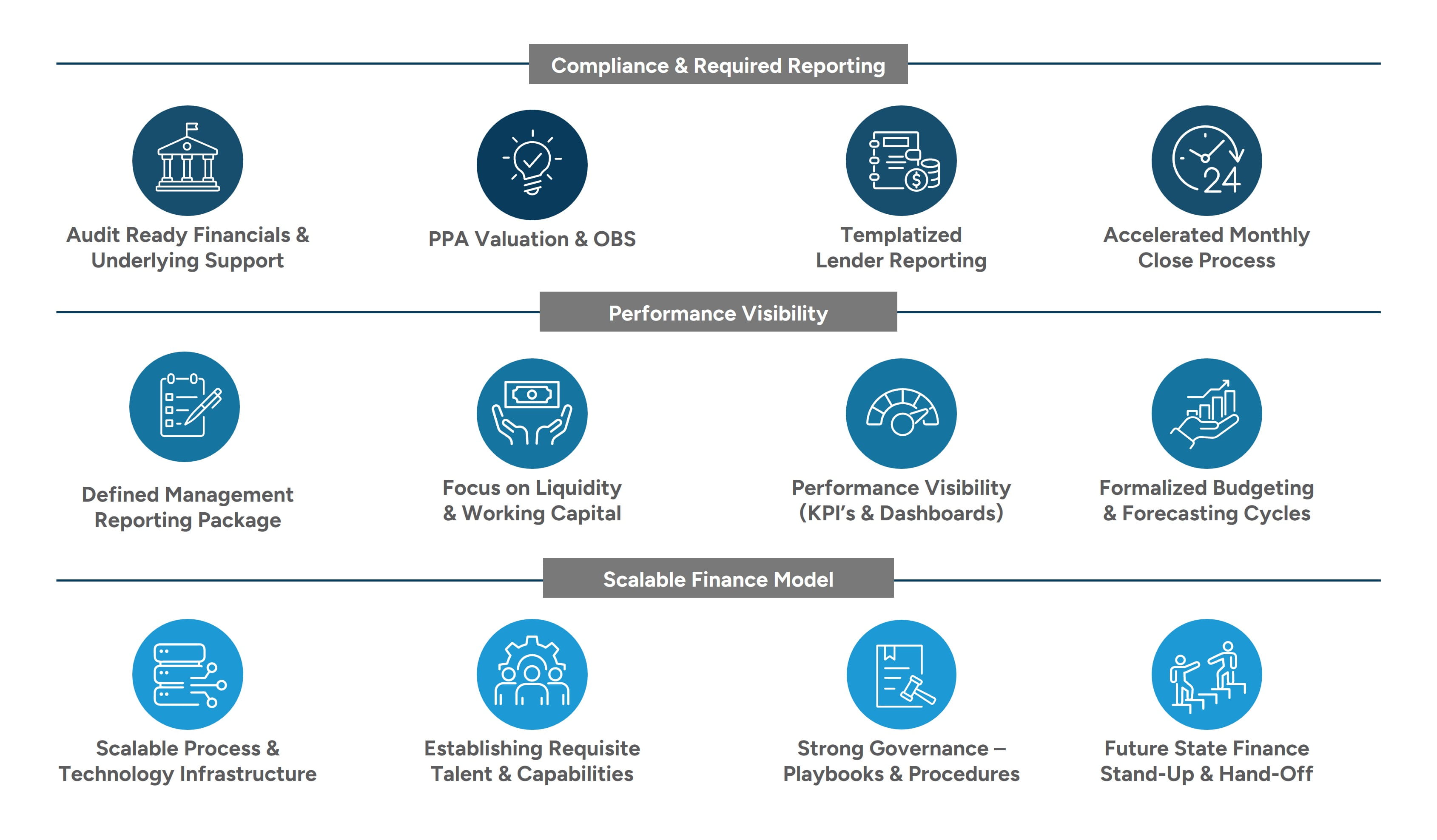
Day 1 Compliance & Required Reporting
The first step in effective onboarding is to establish robust financial processes. This includes transitioning accounting practices, such as moving from cash to accrual accounting, preparing purchase price allocation (PPA) valuations, and developing audit-ready financials. A structured monthly close process must be implemented to provide reliable financial reporting packages that meet both internal and external requirements, such as lender reporting and investor updates.
Equally critical is ensuring compliance with technical accounting standards, including the development of policies and procedures that mitigate risks and prepare the company for future audits.
FP&A and Performance Visibility
Investors and management should collaborate to set up planning and budgeting cadences, develop KPIs tailored to the business, and implement three-statement and 13-week cash forecast models. These tools provide the visibility needed to monitor performance, manage liquidity, and identify trends that drive decision-making. Real-time performance dashboards and reporting packages, including those designed for board and lender communications, should also be prioritized.
Scalable Finance and IT Operating Model
A thorough assessment of the current Finance and IT operating model will identify gaps and inefficiencies that could hinder growth. This includes reviewing organizational structures, delivery models, processes, technologies, and data frameworks.
Once gaps are identified, stakeholders should define a future-state operating model that positions the company for sustainable growth. This may involve selecting and implementing new technologies, optimizing end-to-end processes, and creating a roadmap for continuous improvement.
Commercial and Operational Effectiveness
During onboarding, firms should evaluate revenue streams, customer diversity, and profitability to identify areas for improvement. Supply chain and manufacturing processes should also be analyzed to uncover opportunities for cost savings, efficiency gains, and enhanced capacity utilization.
A playbook tailored to the specific industry of the platform company can help identify and prioritize these opportunities. For example, a manufacturing company may benefit from a detailed spend analysis and sales and operations planning, while a service-oriented business may focus more on vendor analysis and customer concentration risks.
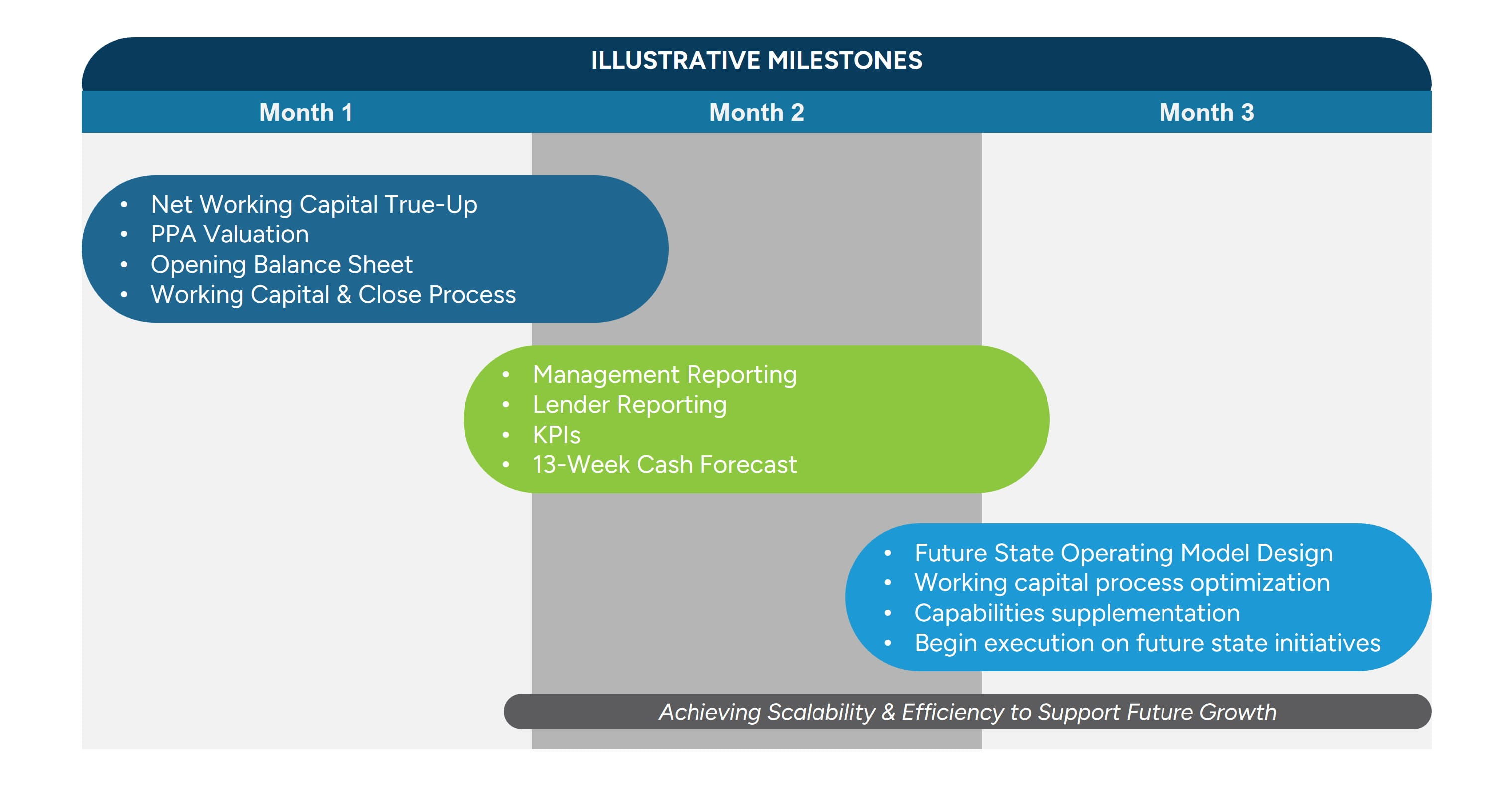
Illustrative Project Timeline
Why to Deploy an Integrated Approach to Capture Synergies
An onboarding playbook’s success hinges on efficient execution. For many PE firms, the question is not what to do but how to do it effectively. A unified approach can unlock significant synergies and streamline the onboarding process.
An integrated approach provided by a single provider offers expertise across accounting, finance, IT, and operations, ensuring a cohesive approach to onboarding. Rather than managing multiple consultants or vendors, PE sponsors can rely on a unified team that understands the full scope of the investment’s requirements. This eliminates inefficiencies, reduces knowledge gaps, and accelerates implementation timelines.
Moreover, an integrated approach can deliver consistency in methodology and deliverables, ensuring alignment across all aspects of the onboarding process. A holistic view enables finance leaders to anticipate interdependencies, mitigate risks, and adapt the playbook to the unique needs of the portfolio company. This streamlines execution and enhances the quality of outcomes, driving faster value creation.
Stout leverages our considerable investment banking, transaction advisory, and valuation experience to assist clients in making sound business decisions. We understand the complexity and uncertainty in completing a deal and are committed to navigating through the "noise" to provide timely, sophisticated, and reliable advice. Learn more about our Transaction Lifecycle Resource Center.