

 Français





Independent wealth management firms have spent much of the past decade getting bigger. The next test is whether that growth produces a business that is more differentiated, more productive, and easier to scale.
Part 1 of this series examined the opportunities and pressures facing the industry, such as intergenerational wealth transfer and aging advisors. Addressing them starts with a clear choice for a wealth management firm: which clients is the firm built to serve, and what commercial proposition will solve the financial problems that matter most to them? That choice should guide the firm’s subsequent investments and growth decisions.
Portfolio construction and core financial planning are increasingly accessible. Technology also gives advisors better tools to personalize their work. Advice remains valuable, but a generic promise of comprehensive wealth management gives clients little reason to choose one firm over another. Differentiation depends on understanding a particular client segment’s circumstances and delivering against them.1
Client Focus Comes First
Schwab’s 2026 Registered Investment Advisor (RIA) Benchmarking Study found that firms with a written marketing plan, ideal client persona (ICP), and client value proposition gained 87% more new clients and 127% more new client assets in 2025 than other firms. The association does not prove causation, but it supports treating client focus, the proposition, and the approach to reaching clients as connected decisions.2
Starting with a picture of the ideal client creates a filter for the firm’s commercial proposition. An attractive capability earns its place when it addresses a recurring need among the clients the firm wants to serve. Without that filter, each new relationship can add another service promise and another variation in delivery.
An Ideal Client Persona Is More Than a Wealth Tier
An asset threshold or a label such as “business owner” is a useful screen. A strong ICP goes further by describing how wealth was created, where it is concentrated, when the client may need liquidity, and which decisions require advice. It also captures how much involvement the client wants in managing those decisions.
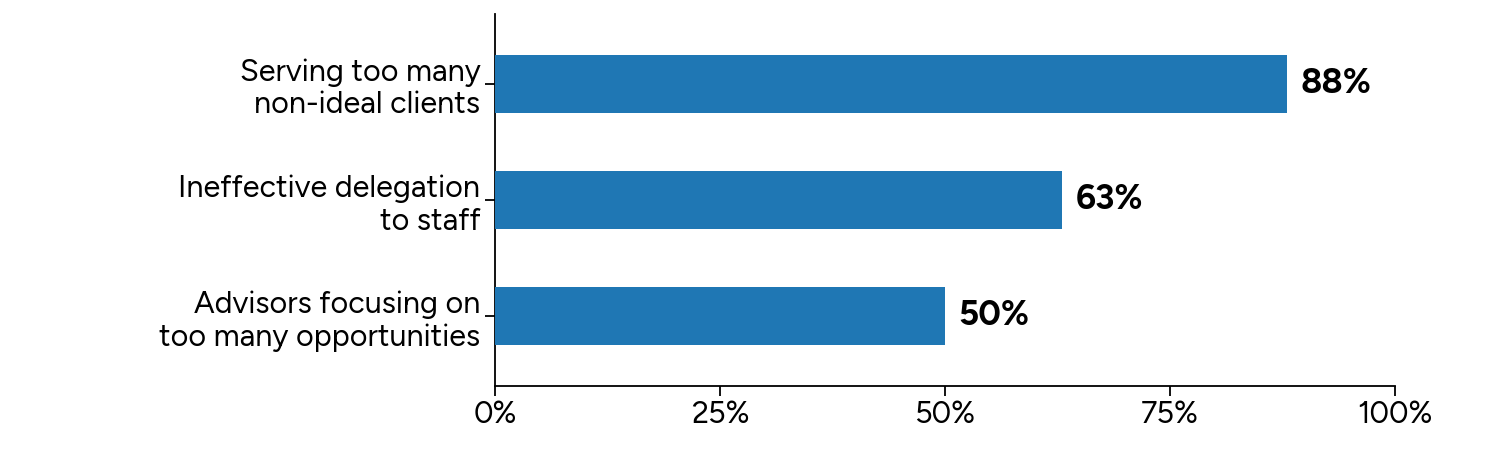
Start with the existing book. Which clients stay, refer others, and deepen their relationships? Where does the firm already have relevant expertise? Which relationships require disproportionate service effort? Cerulli’s practice-management research identifies serving too many non-ideal clients as the most frequently cited major productivity challenge (Figure 1). Client selection therefore belongs in the discussion of how to build a scalable business.
Figure 1. Client Fit Is a Leading Productivity Constraint
Practice-management professionals citing a major challenge, 2025
Source: Cerulli Associates, U.S. Advisor Metrics 2025
Test those hypotheses with client conversations. Ask what prompted the search for an advisor, which decisions remain difficult, and what the client already handles elsewhere. Cerulli describes RIAs developing expertise around specific client personas and using that focus to make referrals more intentional.3
Useful Diagnostic Questions
- Which clients share recurring financial decisions the firm is unusually well placed to support?
- Where does the firm already see stronger conversion, retention, referrals, or share of wallet?
- Which needs should be solved consistently across the ICP rather than reinvented client by client?
- Which client relationships fit the economics and service intensity of the model the firm wants to build?
- What new business should the firm be willing to decline because it pulls the platform away from its target model?
An ICP should be specific enough to change behavior. If defining it does not affect marketing, hiring, advice, investments, or the client experience, it is probably too broad. For example, a technology founder approaching a first liquidity event calls for a different proposition than a retired executive drawing income from a diversified portfolio, even when their net worth is similar.
Illustration: Specializing for Athletes
To illustrate how to build around the decisions that an ICP repeatedly faces, consider an athlete whose substantial earnings arrive early in a career that could end well before traditional retirement. The planning task is to convert that earning window into wealth that can support decades of spending while preserving flexibility for a second career, alongside advice needs specific to athletes such as tax, disability insurance, and fraud. Endorsement and licensing income, along with private business interests, raise considerations that salary alone does not.
For clients who use their playing income to build businesses, the advisory brief expands to other issues, such as the amount of capital that can be committed to ventures without compromising long-term financial security.
A wealth manager who identifies athletes as an ICP would flex its commercial proposition to serve those clients. This could include structuring cash reserves around a relatively short and uncertain earning window, evaluating the financial terms of endorsement and investment opportunities, and helping clients clearly separate capital available for new ventures from assets earmarked to fund their long-term needs. Most importantly, these aren’t generic capabilities; they must be deliberately assembled leveraging scarce talent, technology, and operational excellence to deliver at the highest caliber.
Turn the ICP Into a Commercial Proposition
With the client defined, the commercial strategy should specify the advice the firm provides, the role of the investment portfolio, and the experience that clients can expect. Each choice needs to address a recognizable client need.
Advice Starts With the Decisions That the Client Faces
A founder may need guidance on concentrated equity and the transition from operator to investor. An athlete building business interests may need ongoing coordination of cash flow, commitments, and wealth preservation. Mapping those decisions keeps the proposition focused and makes its value easier to explain.
A broad service menu can still miss the client’s priorities. Limited awareness, a lack of immediate need, and established relationships with other professionals are reasons clients use only a few services. The response should be a relevant, clearly communicated proposition that respects those relationships.4
The relationship advisor does not need to be the expert on every topic. A centralized planning, philanthropy, or investment specialist can support recurring needs across the client base. Other needs may justify an embedded specialist or an external partner, with design choices to federate these roles across the office footprint or centralize them. The appropriate arrangement depends on the frequency and depth of the ICP’s needs.5
Investment Management Must Complement the Client’s Existing Wealth
Portfolio design should begin with the client’s total economic exposure, including assets outside the managed account. A technology entrepreneur may already have substantial exposure to technology and venture capital through company equity, income, and personal investments. Emphasizing access to more venture opportunities could compound that concentration. This caution departs from the common practice of marketing private-market access as a differentiator, and it applies most where clients already hold concentrated exposure.
A more coherent proposition may let the client pursue selected venture investments independently while the managed portfolio emphasizes diversification, liquidity, and long-term wealth preservation. Standard tools for concentrated technology exposure include exchange funds, hedging and collars, completion portfolios, and direct indexing that excludes the technology sector. The advisor should still account for those outside investments when assessing the plan. For an athlete, the managed portfolio might prioritize liquidity and steady income to fund spending after the earning window closes, with business interests held outside it.
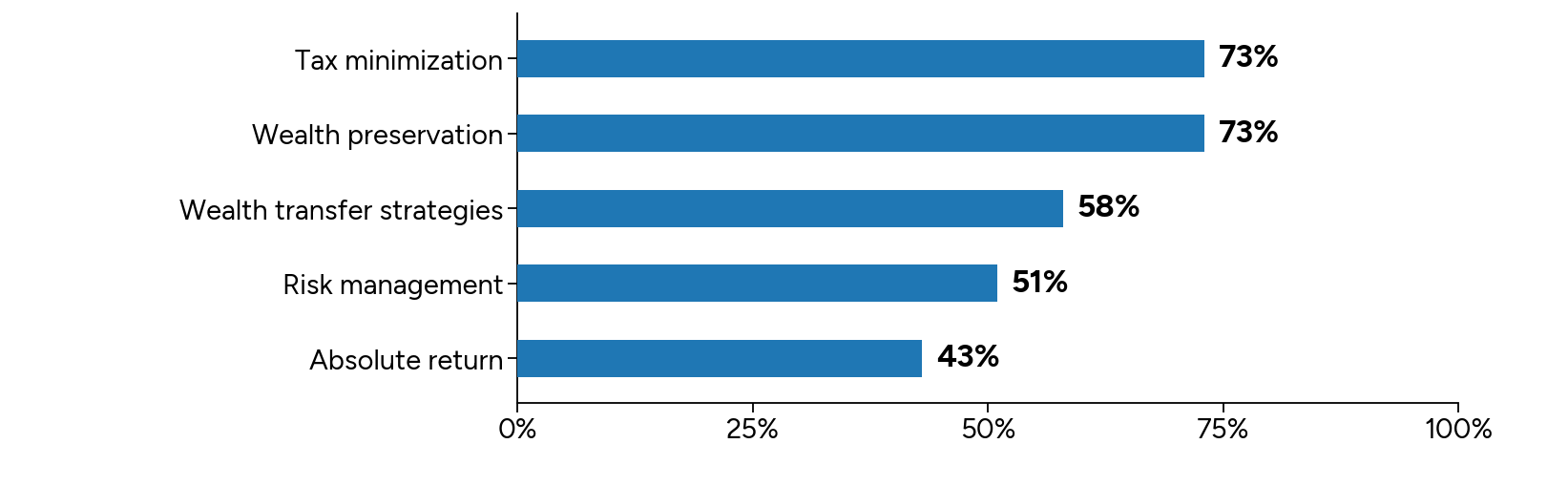
A 2024 survey of private wealth executives reinforces the importance of defining the portfolio’s role: tax minimization and wealth preservation were more frequently described as very important objectives for their high-net-worth clients than absolute return (Figure 2). Returns still matter, but the investment proposition should explain what those returns need to accomplish.
Figure 2. Wealth Preservation and Tax Objectives Shape the Investment Brief
Private wealth executives rating high-net-worth client objectives as very important, 2024
Source: Cerulli Associates, The Cerulli Edge, U.S. Advisor Edition, 4Q 2025
The Delivery Model Should Match How the Client Wants to Engage
High net worth does not mean every interaction should be high touch. Clients may want an advisor closely involved in a business sale while preferring digital access for documents and routine updates. Some work actively with advisors, while others prefer to delegate day-to-day decisions. All can be valuable clients, but their preferred experiences differ.6
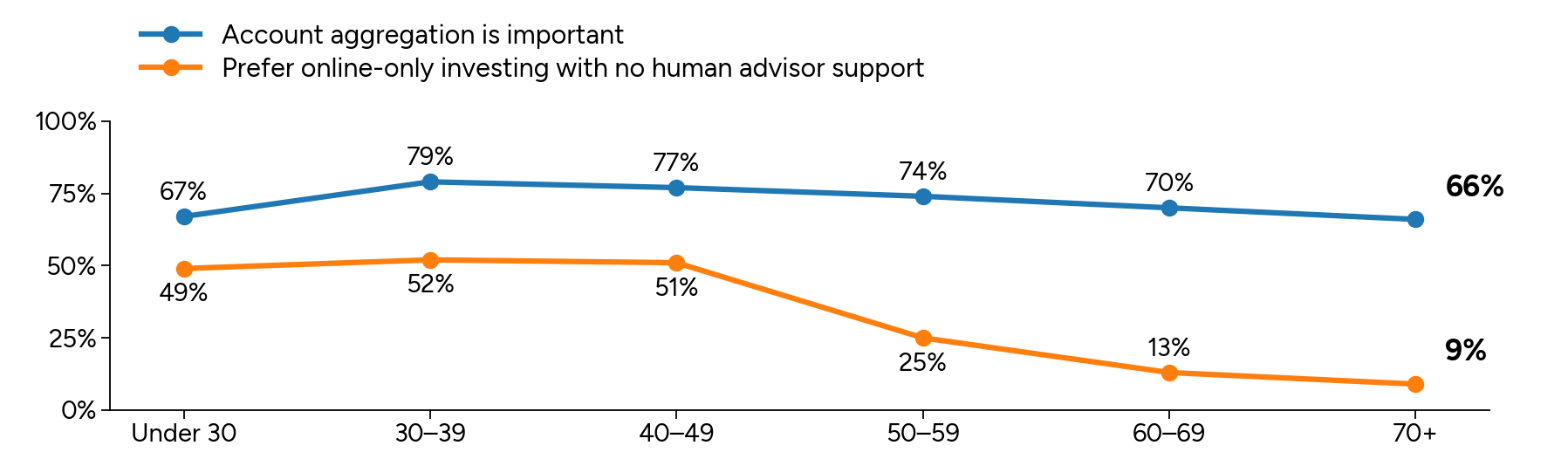
Technology choices should follow those preferences. A 2025 survey of affluent and near-affluent investors shows that access to consolidated account information matters across age groups, while preference for a provider with no human advisor support falls sharply among older households (Figure 3). The same data show that about half of investors under 50 prefer online-only investing, which is a headwind for full-service firms serving younger clients, such as founders. For those clients, the proposition has to show what human advice adds that a digital-only provider cannot. The task is to choose the right combination of convenience and human judgment for the ICP.
Figure 3. Digital Access Has Broader Appeal Than Digital-Only Advice
Share agreeing with each statement, by head-of-household age, 2025
Source: Cerulli Associates, The Cerulli Edge, U.S. Advisor Edition, 1Q 2026
The practical promise starts with deciding who leads the relationship, when a specialist joins, what prompts a proactive review, and which requests clients can complete themselves. Technology can make that experience more consistent. For an athlete, the promise might add closer contact around contract negotiations and a lighter cadence in the off-season. Individual client preferences should guide personalization within that framework.
A Clear Strategy Guides Growth Decisions
For a multi-office RIA or independent broker-dealer, focus does not require every advisor to serve the same ICP. A firm can support several deliberate ICPs when each has a clear proposition and the platform provides the relevant expertise. Because specialist time and platform resources are finite, leadership should decide which ICPs warrant dedicated investment and which to sequence later. Independence works better when advisors understand both the resources available and the service promises they can reliably make. At an independent broker-dealer, where advisors are independent contractors, the firm enables an ICP rather than mandates one.
Leadership should capture those choices in a short commercial playbook: the clients the firm seeks, their recurring needs, the commercial proposition and delivery model, and the boundaries of the relationship. Test it with advisors and clients, then review whether new relationships fit the intended model. Existing clients outside any ICP need a considered plan, such as tiered service, a handoff to an associate advisor, account minimums, or a respectful transition out, as the business evolves. That foundation provides a practical test for the execution decisions that will follow.
What This Means Going Forward
A coherent client strategy gives an independent wealth manager a foundation for scale. It allows the firm to standardize the parts of the experience where consistency matters and personalize the parts where client circumstances differ. It clarifies how scarce advisor time should be spent, where specialists should be used, and what role the managed portfolio should play alongside the client’s other assets and exposures.
The next article in The Future of Wealth Management will focus on the execution levers that follow from this foundation, including M&A, technology and operations, service expansion, pricing, and other sources of value creation.
- Cerulli Associates, U.S. Advisor Metrics 2025
- Charles Schwab, Insights from the 2026 RIA Benchmarking Study
- Cerulli Associates, U.S. RIA Marketplace 2025
- Cerulli Associates, The Cerulli Edge, U.S. Retail Investor Edition, 4Q 2025
- Cerulli Associates, U.S. Advisor Metrics 2025
- Cerulli Associates, The Cerulli Edge, U.S. Retail Investor Edition, 2Q 2026
This article is provided for informational purposes only and does not constitute investment, legal, tax, or accounting advice.


