Français


On February 27, 2026, the U.S. and Israel launched a coordinated attack on Iran dubbed “Operation Epic Fury,” targeting military, nuclear, government, and intelligence sites across Iran. President Trump called on the Iranian public to “seize control of your destiny” by rising up against the Islamic leadership — signaling regime-change ambitions, not a contained one-and-done operation like June 2025.1
Iran retaliated immediately firing missiles and drones toward Israel and at U.S. military bases across the Gulf region, including bases in:
- Saudi Arabia
- The UAE
- Qatar
- Bahrain
- Kuwait
Iranian media reported that the Strait of Hormuz is closed, and a senior Islamic Revolutionary Guard Corps (IRGC) official stated that, for any vessels passing through the strait, Iran “will set those ships ablaze.”2
Several of Iran’s most senior political and military leaders have been reported killed so far, with some names fully confirmed by both Iranian state media and U.S./Israeli officials, and others reported by one side but not yet fully corroborated. The core confirmed list from multiple mainstream outlets and Iranian state media is:
- Ayatollah Ali Khamenei – Supreme Leader of Iran, killed in the initial wave of U.S.–Israeli strikes on his compound in Tehran on February 28, 2026.3
- Ali Shamkhani – Long‑time senior security official and adviser to Khamenei (former Supreme National Security Council secretary), reported killed in the same operation.4
- Mohammad Pakpour – Commander-in-chief of the Islamic Revolutionary Guard Corps (IRGC) Ground Forces, confirmed killed in the strikes.5
- Abdolrahim Mousavi – Chief of Staff of Iran’s Armed Forces, also reported killed in the attacks on senior defense leadership.6
- Aziz (Amir) Nasirzadeh – Iran’s minister of defense and former air force commander, killed while attending a senior Defense Council meeting.7
Iran's Oil Production and Exports
Iran currently produces approximately 3.1–3.5 million barrels per day of crude oil, with total liquids output (including condensates and NGLs) around 4.5–4.8 mb/d. As of December 2025, Iran managed to export around 1.9 million barrels per day despite U.S. sanctions, according to the IEA.8 The majority of crude exports head to China, Iran's only remaining major customer.9
Flows most at risk:
Nearly 90% of Iran's crude exports leave through Kharg Island, passing via the Strait of Hormuz.10 Reports suggest explosions were heard at Kharg Island and Dezful, which could indicate targeting of oil facilities. If Kharg Island infrastructure is damaged, that alone could remove 1.5–1.9 mb/d of Iranian exports. Iran also rushed to pre-position exports ahead of strikes: satellite imagery and shipping data indicated an unusual surge in tanker activity at Iranian terminals throughout the week as Tehran tried to maximize revenue before potential infrastructure damage.11
The Strait of Hormuz: The Key Variable
About 20 million barrels of oil transited through the Strait of Hormuz each day — roughly a quarter of the world's seaborne oil trade.12 The strait is approximately 50 km or 21 miles wide at its narrowest point, and its designated shipping lanes fall entirely within the territorial waters of Iran and Oman, giving Tehran geographic leverage.13
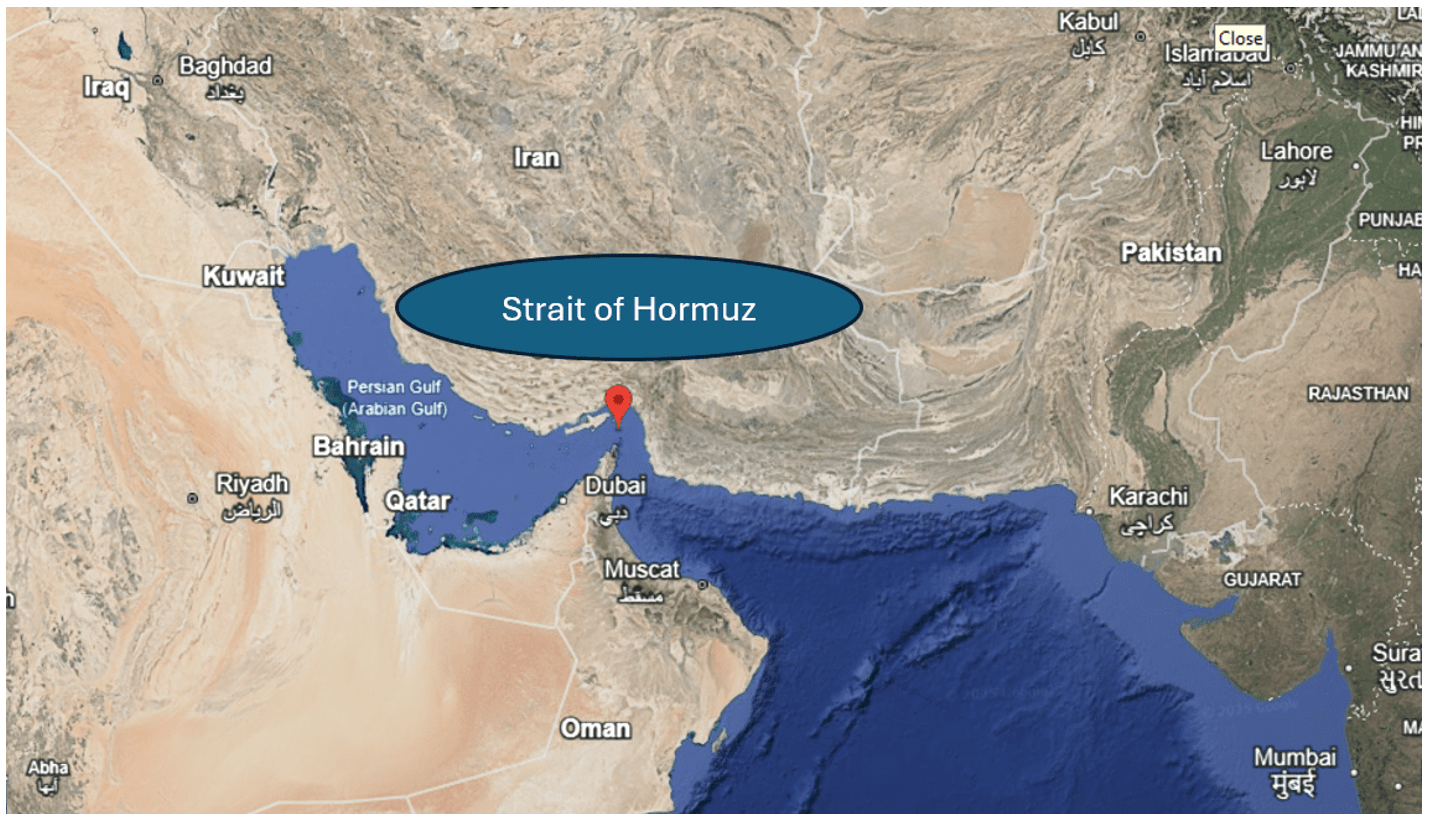
Iran has the tools for disruption: fast-attack boats, anti-ship cruise missiles, naval mines, and submarines designed for asymmetric warfare. Reports indicate ships are receiving messages from the IRGC about the strait's closure. Greece's shipping ministry already advised Greek-flagged vessels to avoid the Arabian Gulf, the Gulf of Oman, and the Strait of Hormuz.14 Insurance rates are expected to increase dramatically, and ships with business connections to the U.S. or Israel may be unable to obtain coverage.
Even without a full physical blockade, if tanker operators and their insurers de facto refuse transit, the effect is equivalent. Kpler's senior crude analyst estimated a single-day disruption could push oil to $120–$150 per barrel.15
Historical Precedent
The closest analogy to reference is a hybrid of three past events:
- The June 2025 strikes on Iran: During this most recent precedent, Brent spiked ~$5 to $74 then retraced within days, as no supply was disrupted. But today's operation is far larger in scope and ambition.
- The September 2019 Abqaiq/Khurais attacks: Drone/missile strikes temporarily removed 5.7 million bpd of Saudi capacity, triggering an immediate 15% price spike.16 Prices normalized within weeks as Saudi Aramco restored output rapidly. The lesson: physical supply disruption moves prices violently, but restoration speed matters enormously.
- The 1980s Tanker War: The most ominous parallel. During the Iran-Iraq War, both sides attacked shipping in the Gulf, and Iran mined the Strait of Hormuz. This prompted U.S. military action in Operation Earnest Will to escort tankers.17 Oil traded at sustained premiums for years. If today's conflict becomes protracted, this is the framework.
The key takeaway from all three: the duration and physical reality of supply disruption matters far more than the initial shock. Markets spike on fear but mean-revert quickly unless barrels actually go offline.
Three Scenarios
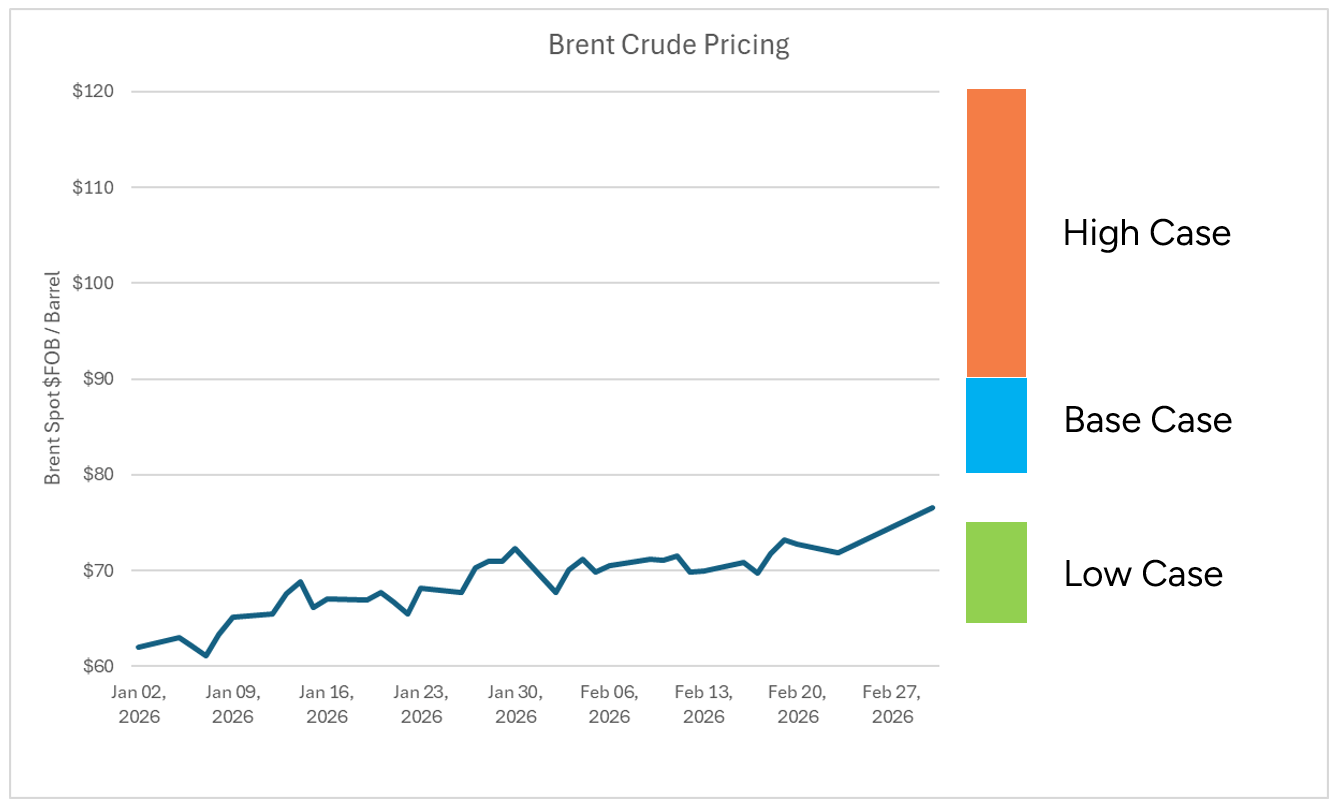
Below are three different outcomes for future oil prices, dependent on Iran’s ultimate response to the recent attacks. All prices are referenced for Brent Crude, the benchmark for foreign oil. Brent crude generally trades at a premium of approximately $6 to $7 per barrel over West Texas Intermediate (WTI), the U.S. benchmark for oil prices.
High Oil Price Case: Sustained Disruption
- Brent Crude Price: $90–$120 per bbl
- % Change: +25% to +65%
Core Assumption: Iran sustains Strait of Hormuz disruption (mines, harassment, insurance deterrence) for days to weeks, and/or retaliatory strikes damage Gulf state energy infrastructure. The conflict becomes protracted with no rapid ceasefire.
Base Case: Elevated Prices with Limited Disruption
- Brent Crude Price: $80–$90 per bbl
- % Change: +10% to +25%
Core Assumption: Iran's Hormuz closure threat proves largely rhetorical or lasts only hours/days. U.S. naval forces keep the strait open for commercial traffic. The conflict follows an intense one to three week period and eventually reaches a ceasefire, similar to but longer than the 12-day war in June 2025.
Low Oil Price Case: Rapid De-Escalation, Risk Premium Compresses
- Brent Crude Price: $65–$75 per bbl
- % Change: -10% to +5%
Core Assumption: A ceasefire is reached within days (as happened in June 2025). Iran's retaliation is largely intercepted and symbolic. Hormuz remains fully open.
These three outcomes are illustrated below, following Brent’s year-to-date history.
Given the current level of uncertainty about next steps in this conflict, we will leave outcome probabilities to Kalshi and other such platforms.
WTI Strip Prices Increase
Spot prices and futures prices for the West Texas Intermediate (WTI) contract increased approximately $8.50 per barrel in the near term and increased approximately $0.25 over the longer term.
WTI Strip Prices — One Month Change
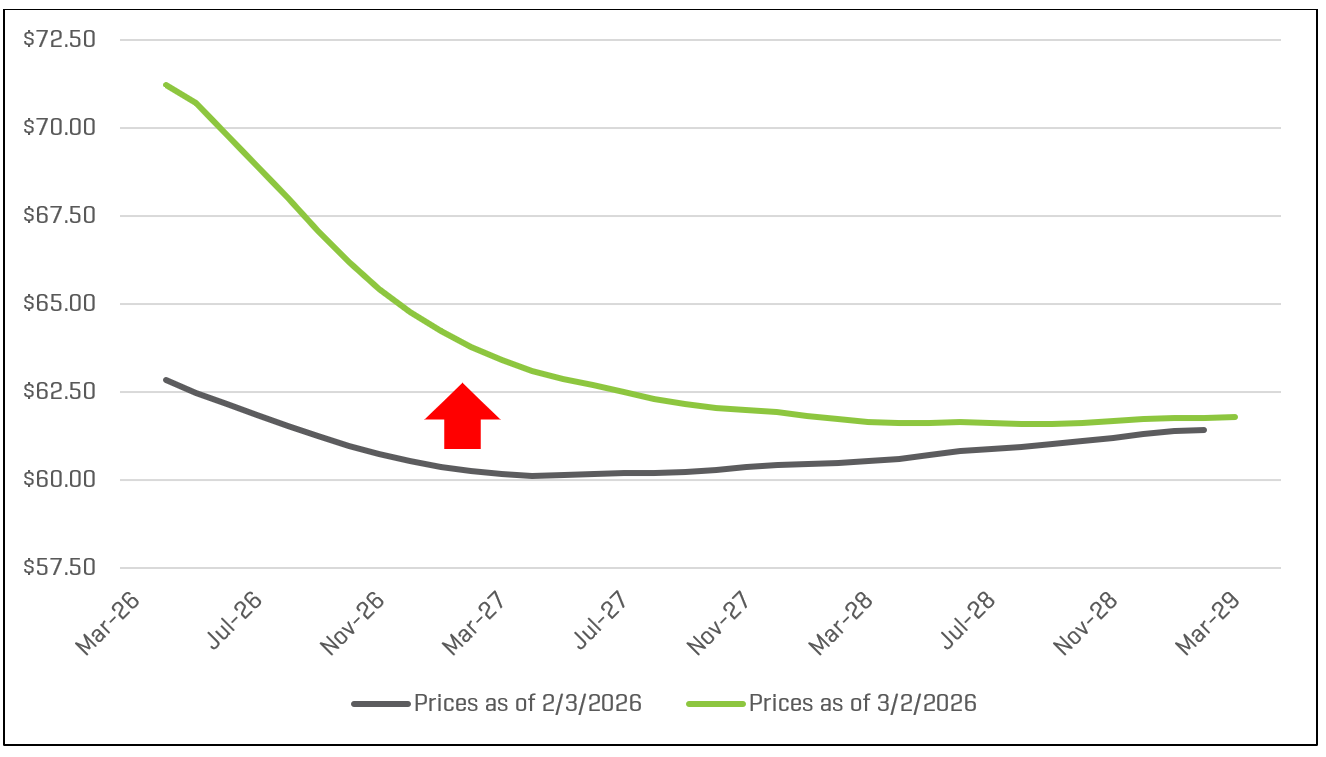
As shown, the oil price curve has shifted to a state of “backwardation,” reflecting the market’s expectation of lower future spot prices over the longer term.
Oil Price Outlook
The price distribution below shows the crude oil spot price on March 3, 2026, as well as the predicted crude oil prices based on options and futures markets. Light blue lines are within one standard deviation (σ) of the mean, and dark blue lines are within two standard deviations.
WTI Crude Oil $/BBL
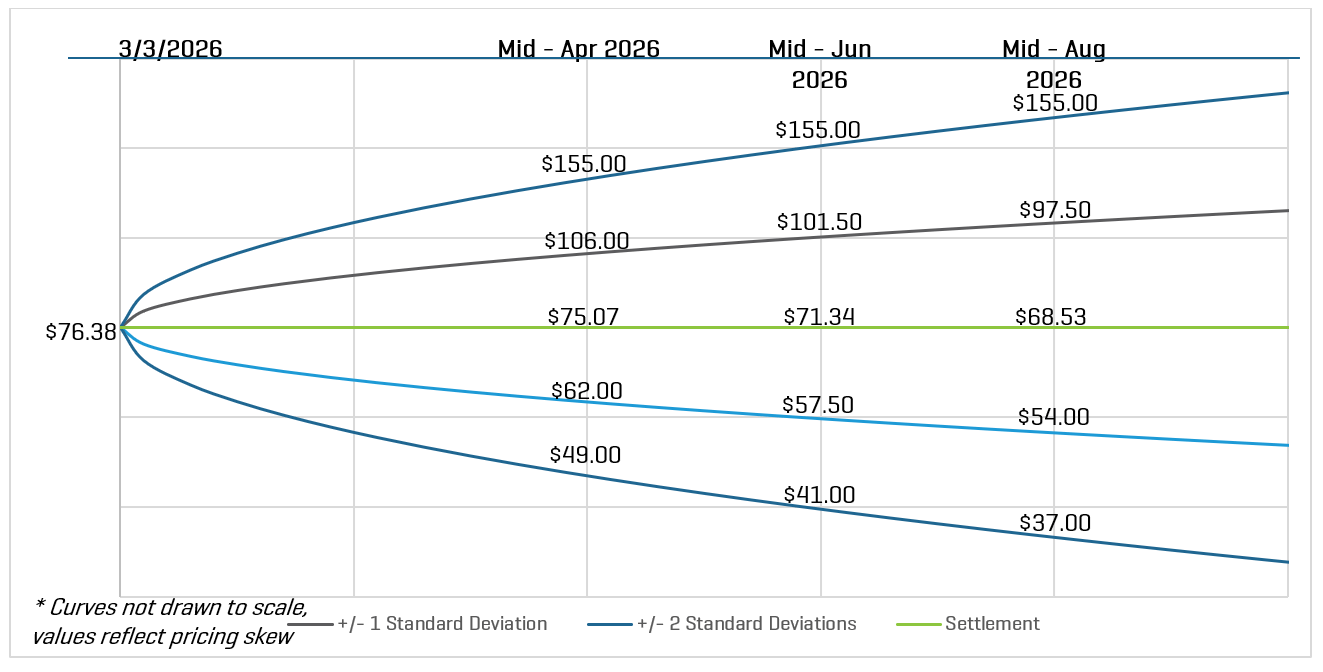
Based on these current prices, the markets indicate there is a 68% chance oil prices will range from $57.50 and $101.50 per barrel in mid-June 2026. Likewise, there is roughly a 95% chance that prices will be between $41.00 and $155.00. By mid-August 2026, the one-standard deviation (1σ) price range is $54.00 to $97.50 per barrel, and the two-standard deviation (2σ) range is $37.00 to $155.00 per barrel.
Insights
Remember that while option prices and models reflect expected probabilities rather than certain outcomes, they still remain a useful tool for assessing market expectations and risk. Throughout most of 2023 and 2024, crude oil spot prices generally fluctuated within the range of $70 to $90 per barrel. During that period, we observed general increases in futures price volatilities as prices approached the upper and lower bounds of that range. In 2025, crude oil spot prices generally decreased throughout the year. For mid-August 2026 pricing as of March 3, 2026, the 1σ range had a spread of $43.50 per barrel, and the 2σ range had a spread of $118.00 per barrel, indicating a general increase in spreads compared to recent months. Following the recent military conflict involving Iran and U.S.-Israeli forces, we have observed significant near-term price increases due to geopolitical risk and potential supply disruptions. However, longer term pricing has remained relatively more stable, which may reflect expectations that supply conditions will return to normal if tensions ease.
- Daniel Estrin, Greg Myre, Jane Arraf, and Chandelis Duster, “Iran's supreme leader, Ayatollah Ali Khamenei, has been killed,” National Public Radio, February 28, 2026.
- “Iran claims Hormuz Strait is closed, threatens to set shipping there ‘ablaze’,” Reuters and Times of Israel, March 3, 2026.
- Priyanka Shankar, "Who are Iran’s senior figures killed in US-Israeli attacks?" Al Jazeera, March 1, 2026.
- Camila Domonoske and Julia Simon, “How could the U.S. war in Iran affect the world's oil supply?” February 28, 2026.
- "Aziz Nasirzadeh To Mohammad Pakpour, Top Iran Leaders Killed In US-Israel Strikes," NDTV World, March 1, 2026.
- Henry Zwartz, "The US and Israel have struck Iran: Who has been killed?" ABC News, February 28, 2026.
- "Key Iranian leaders killed in US-Israel strikes," The Economic Times, March 2, 2026.
- "Iran confirms two other top commanders killed in US-Israel strikes," Iran International, March 1, 2026.
- Subhankar Paul, “209 billion barrels: Iran’s oil muscle looms over global markets as conflict escalates,” Business Today, February 28, 2026.
- Ibid.
- Michael Kern, “Oil Markets Brace for Volatility As U.S.-Israel Launch Strikes Across Iran,” February 28, 2026.
- Google Earth, June 30, 2025.
- Elis Gjevori, “Iran-US tensions: What would blocking Strait of Hormuz mean for oil, LNG?” Al Jazeera, February 22, 2026.
- Fareed Rahman, “Iranian Navy tells ships to avoid Strait of Hormuz,” The National, February 28, 2026.
- Tony Jackson, “Oil Prices Surge 3-5% as US-Israel Strikes on Iran Spark Fears of Supply Disruptions Through Strait of Hormuz,” International Business Times, March 1, 2026.
- Subhankar Paul, “209 billion barrels: Iran’s oil muscle looms over global markets as conflict escalates,” Business Today, February 28, 2026.
- “Iran Conflict and the Strait of Hormuz: Oil and Gas Market Impacts,” Congress.gov, report, August 4, 2025.