Deutsch



A New Demand Thesis
For the past forty years U.S. power demand grew at 1% a year, and every plan in the electric utilities sector was built on that number. The recently announced NextEra-Dominion deal is a $420 billion bet that the number no longer applies. NextEra and Dominion announced an all-stock merger on May 18, 2026. Given the combined enterprise value, the deal is the largest utility transaction that Enverus has tracked, and the largest energy deal on record, bigger than Exxon-Mobil in 1998 or Shell-BG in 2015.1
Figure 1. Top 10 Electric Generation Owners in the U.S. (in GW). Source: NextEra/Dominion via RBN Energy.
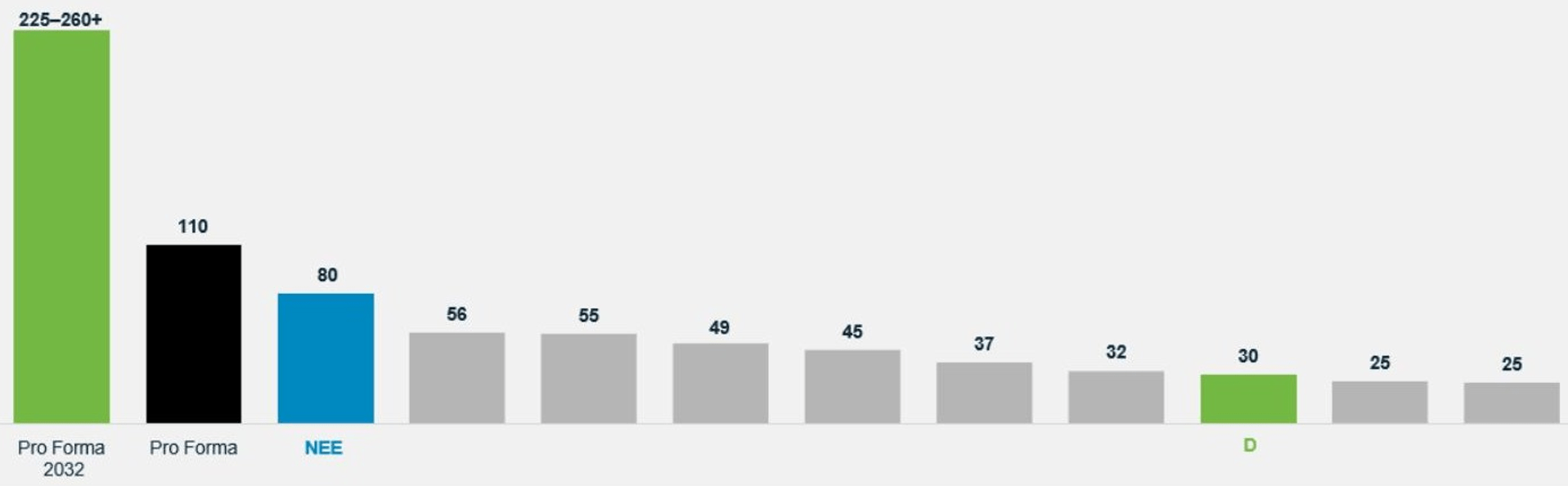
At closing, the combined company holds about 110 GW of operating generation and an enterprise value near $420 billion. The development pipeline for the utility targets up to 150 additional GW for large-load customers, mostly data centers.2,3 Management has floated estimates of 225 to 260 GW of capacity by 2032, funded by about $59 billion of capex a year, with the rate base growing around 11% annually over that stretch. It’s also the biggest in a string of deals built on the same premise: serving AI load is rewriting what the U.S. utility sector has to look like.
Demand Drivers
U.S. electricity demand has grown at a manageable 1% a year for four decades. Every integrated resource plan, transmission plan, and rate case outcome was built on that number. This long-time rule of thumb no longer holds in a jurisdiction with future data-center buildout.
Dominion’s Virginia footprint hosts the world’s densest concentration of hyperscale data centers — Alphabet, Amazon, Microsoft, Meta, and Equinix among them.4 Florida Power & Light, NextEra’s main regulated utility, is the largest natural gas consumer in the country. Its gas pipelines move around 2.2 Bcf/d, on par with an LNG export terminal.5
Nationally, power prices are up about 40% over the last five years, roughly 7% a year, and the sharpest moves are in the states doing the most AI buildout: Virginia, Maryland, and Pennsylvania.6
When the deal was announced, John Ketchum, who runs the combined company, said on the call that the combined scale “translates into capital and operating efficiencies.”7
Rate Base or Projects in Queue?
There’s also a different reading floating around the power-analyst world: the deal isn’t about the rate base, it’s about the queue. As of early 2026, Dominion’s interconnection queue held about 70 GW of large-load requests, with 25 GW having confirmed dates through 2031. The other 45 GW are still under study. Dominion’s all-time peak, set in January 2025, was 24.7 GW. In comparison, the expected queue is almost three times what the grid currently serves at peak.8
Dominion has also reported about 51 GW of data-center capacity already in-contract, up 2.5 GW expected between December 2025 and May 2026.9,10 Under this viewpoint, what NextEra is actually buying is not the customer base or the regulated earnings. It’s a queue position, physical and regulatory and political, inside the one U.S. service territory where hyperscale demand at this scale runs through a single regulated monopoly grid.
Either way you read it (rate-base growth or queue control), the bet depends on forecasted AI demand actually showing up as firm, served load.
Key NextEra/Dominion Merger Objectives
Speed-to-deployment
At a December 2025 investor day, NextEra laid out a “Bring Your Own Generation” approach: a near-term “hook” of solar, batteries, and gas-fired reciprocating engines on a data-center site in roughly 18 months, then a medium-term “hub” in 2030–2032 that adds combined-cycle capacity.11 The merged company can run that playbook across a bigger footprint, with utility interconnection, gas supply, and long-term power contracts all sitting under one counterparty.
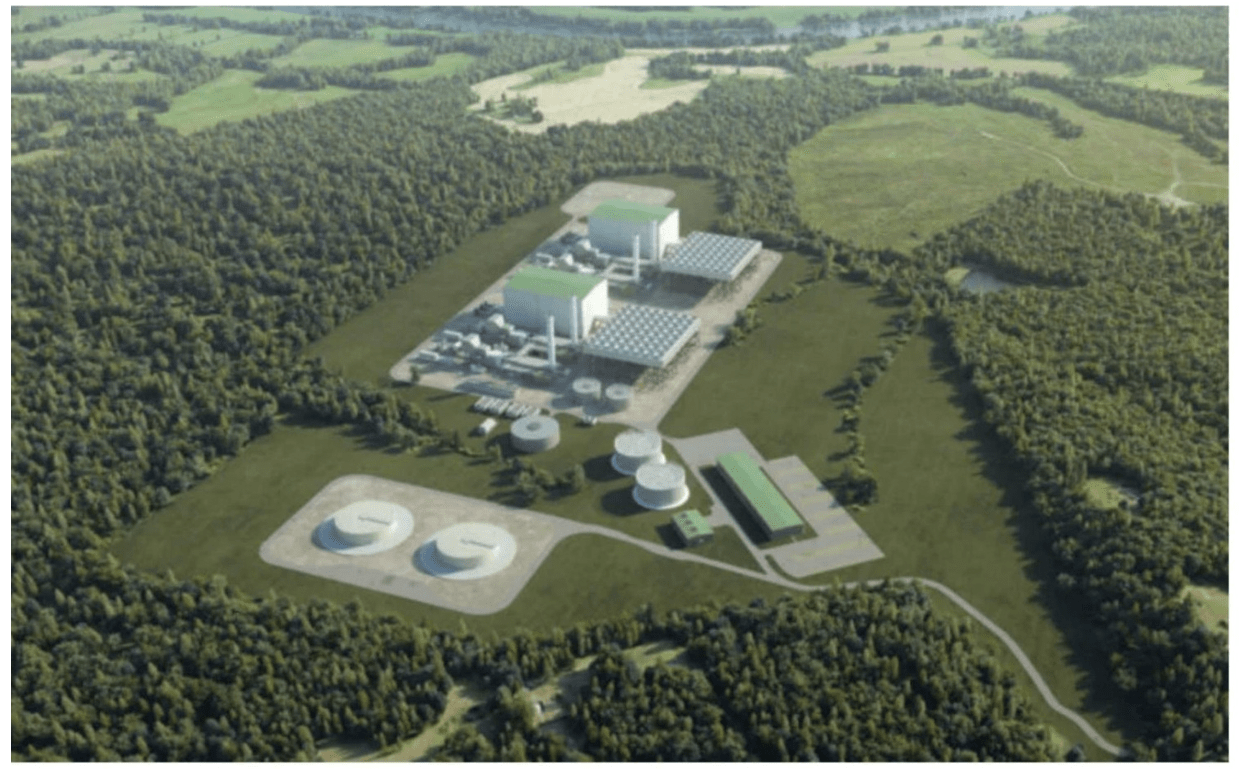
Figure 2. Dominion Energy Virginia’s planned Cumberland Energy Center, a 3 GW combined-cycle facility slated to start up in 2033–2034. Source: Dominion Energy via RBN Energy.
Fuel and technology diversity
The combined fleet leads in renewables, batteries, and gas-fired generation, and owns the second-largest nuclear fleet in the country.12 FPL alone runs more than 37 GW, including over 20 GW of combined-cycle and 3 GW of combustion turbines.13 Dominion’s regulated utilities hold more than 23 GW in Virginia and the Carolinas, plus another roughly 6 GW in South Carolina.
Regulatory footprint
The combined company operates in Florida, Virginia, North Carolina, and South Carolina, which means approval from four state PSCs.14 The deal also bundles $2.25 billion of proposed bill credits for Dominion customers in Virginia and the Carolinas across the first two years post-close, dual headquarters in Juno Beach and Richmond, and 18 months of job protection plus 24 months of compensation protection for Dominion employees.15
The companies’ disclosed pipeline adds roughly 115–150 GW of new generation over the next decade:
- 77–108 GW from NextEra Energy Resources for 2026–2032
- 16 GW from FPL’s 2026 Ten-Year Site Plan
- 11 GW from Dominion’s Virginia/North Carolina and South Carolina IRPs
- 4 GW from Virginia’s storage mandate
- 10 GW or more of incremental data-center opportunity16
Summary
NextEra/Dominion is a new form of utility deal, compared to those seen over the last decade. That wave was about rate-base optimization and unloading unregulated assets. This wave is built around one specific operating problem: serving AI-driven load growth at a pace and scale that smaller platforms could not finance on their own. Whether the underlying thesis holds depends on how much of the forecasted load actually materializes, the cost-allocation frameworks state regulators sign off on, how the politics in Virginia land, and how the combined company executes against a capital program bigger than anything the U.S. utility sector has run before.
WTI Strip Prices Decrease
Spot prices and futures prices for the West Texas Intermediate (WTI) contract decreased approximately $20.25 per barrel17 in the near term and decreased by approximately $2.50 over the longer term.18 This marked change is based on the expectation that the war with Iran is actually settled and oil flow through the Strait of Hormuz will return.
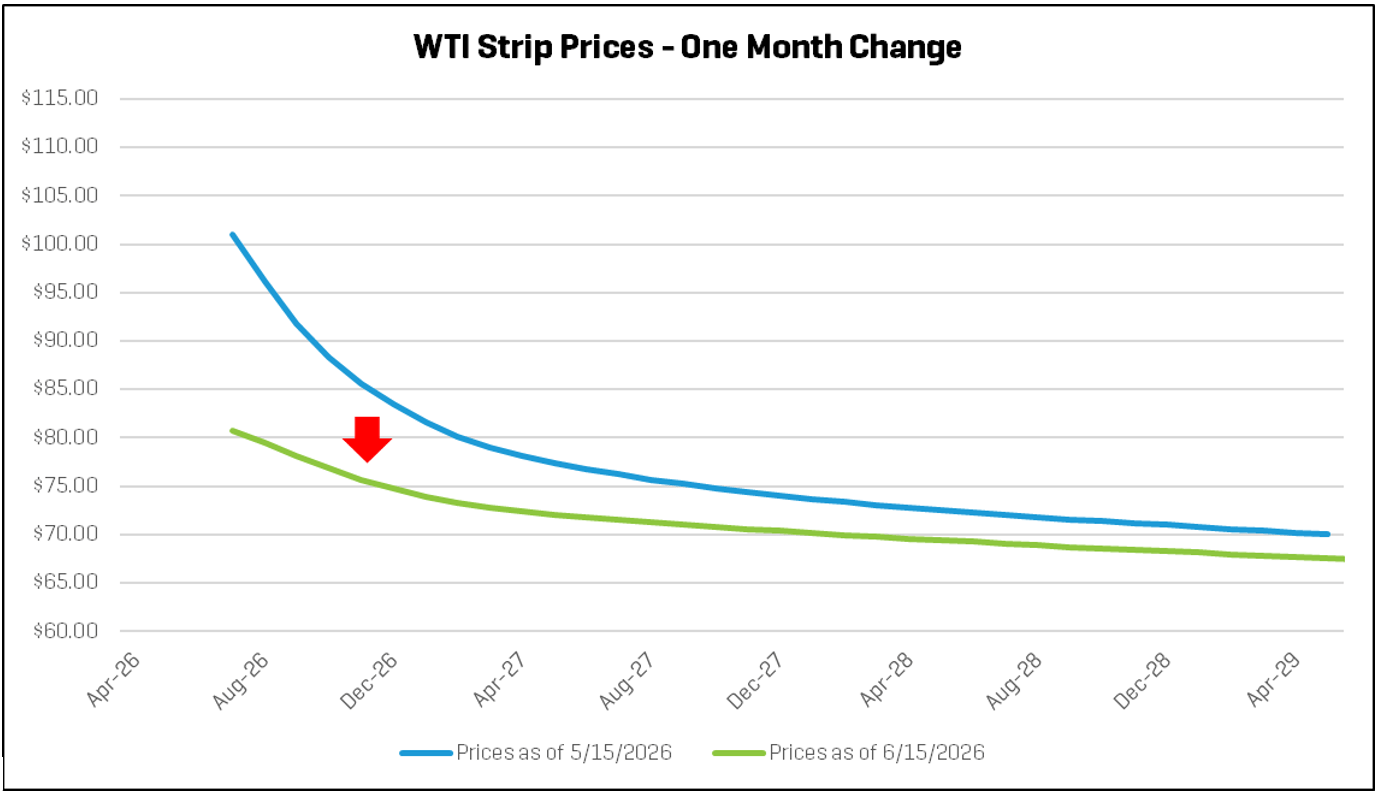
As shown, the oil price curve has maintained a state of “backwardation,” reflecting the market’s expectation of lower future spot prices over the longer term.
Oil Price Outlook
The price distribution below shows the crude oil spot price on June 16, 2026, as well as the predicted crude oil prices based on options and futures markets. Light blue lines are within one standard deviation (σ) of the mean, and dark blue lines are within two standard deviations.
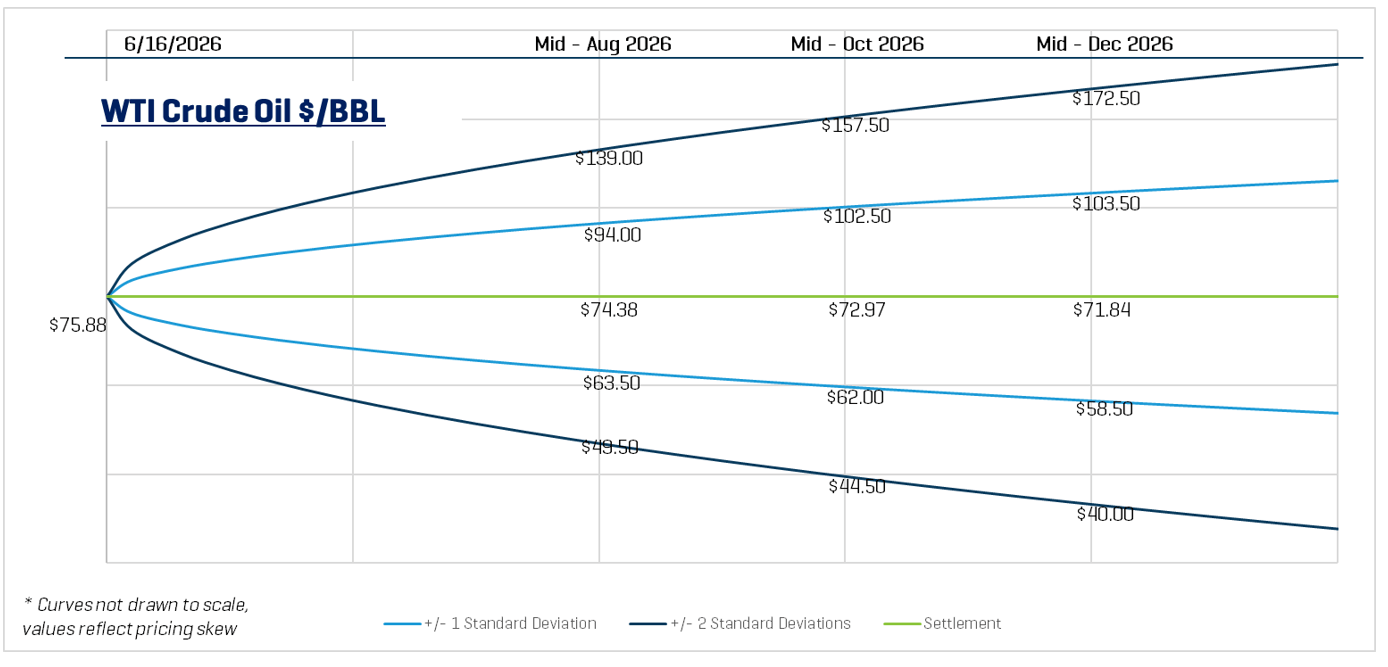
Based on these current prices, the markets indicate there is a 68% chance oil prices will range from $62.00 to $102.50 per barrel in mid-October 2026. Likewise, there is roughly a 95% chance that prices will be between $44.50 and $157.50. By mid-December 2026, the one-standard deviation (1σ) price range is $58.50 to $103.50 per barrel, and the two-standard deviation (2σ) range is $40.00 to $172.50 per barrel.
Insights
Remember that while option prices and models reflect expected probabilities rather than certain outcomes, they still remain a useful tool for assessing market expectations and risk. Throughout most of 2023 and 2024, crude oil spot prices generally fluctuated within the range of $70 to $90 per barrel. During that period, we observed general increases in futures price volatilities as prices approached the upper and lower bounds of that range. In 2025, crude oil spot prices generally decreased throughout the year. For mid-December 2026 pricing as of June 16, 2026, the 1σ range had a spread of $45.00 per barrel, and the 2σ range had a spread of $132.50 per barrel, indicating a general increase in spreads compared to recent months.
- Enverus, Power Pulse, Vol. 2, No. 5 (May 20, 2026), “Utility mega-merger of NextEra & Dominion sets energy record,” pp. 1, 9.
- Ibid.
- NextEra Energy, May 18, 2026, investor presentation, “Growth Pipeline Could More Than Double 110 GW Capacity by ’32,” accessed via Enverus docFinder.
- Housley Carr, “We Are the Champions – NextEra Energy/Dominion Combo May Accelerate Gas-Fired Plant Buildout,” RBN Energy (May 20, 2026).
- Carr, “We Are the Champions,” RBN Energy (May 20, 2026).
- Eric Revell, “NextEra bets $66.8B on AI power boom with Dominion Energy acquisition,” Fox Business (May 18, 2026); Christine Mui, “NextEra’s $67 billion Dominion takeover creates world’s largest utility,” Fortune (May 18, 2026).
- Enverus, Power Pulse (May 20, 2026), “Utility mega-merger of NextEra & Dominion,” pp. 1, 9.
- ElectronEconomics, “NextEra’s reported bid for Dominion isn’t a bet on regulated utility earnings. It’s a bid to own the interconnection bottleneck at the centre of the AI power buildout,” Electron Economics (May 16, 2026).
- ElectronEconomics, “NextEra’s reported bid for Dominion isn’t a bet on regulated utility earnings,” Electron Economics (May 16, 2026).
- Lisa Martine Jenkins, “The NextEra-Dominion tie-up is a mega-deal for the AI era,” Latitude Media (May 19, 2026), citing Nick Zenkin, Latitude Intelligence, and Jefferies research notes.
- Carr, “We Are the Champions,” RBN Energy (May 20, 2026).
- Enverus, Power Pulse (May 20, 2026), “Utility mega-merger of NextEra & Dominion,” pp. 1, 9.
- Carr, “We Are the Champions,” RBN Energy (May 20, 2026).
- Carr, “We Are the Champions,” RBN Energy (May 20, 2026).
- Enverus, Power Pulse (May 20, 2026), “Utility mega-merger of NextEra & Dominion,” pp. 1, 9.
- NextEra Energy, May 18, 2026, investor presentation, “Growth Pipeline Could More Than Double 110 GW Capacity by ’32.”
- Versus May 15, 2026.
- Ibid.