Italiano



Crude exports from the Persian Gulf have recovered sharply from disruptions related to the Iran conflict earlier this year. Yet U.S. motorists and fuel-intensive businesses continue to face elevated gasoline and diesel prices. The mismatch reflects constraints in refining and finished-fuel distribution, not crude supply alone.
For the week of October 26, 2026, the U.S. Energy Information Administration (EIA) reported these national average retail prices:
- Regular gasoline at $4.27 per gallon
- On-highway diesel at $6.35 per gallon1
The key distinction is that restored crude shipments have not produced an equivalent recovery in the supply of gasoline and diesel. Refinery outages, depleted fuel inventories, transportation costs in some markets, and geopolitical uncertainty can sustain pressure on pump prices even as crude flows normalize.
Middle East Supply Risks Remain
The most immediate source of pressure remains the ongoing conflict in the Middle East and the vulnerability of critical oil infrastructure. Renewed attacks on shipping and Saudi Arabian energy facilities in October increased concerns about the reliability of regional supply. The risk also extends to alternative export routes that were designed to lessen dependence on the Strait of Hormuz.2
Although Persian Gulf crude exports have recovered to approximately their prewar levels, buyers remain concerned that renewed attacks on tankers or export infrastructure could disrupt shipments and increase delivery costs.
To hedge against another interruption, refiners may secure supplies early or pay more for reliable delivery. On October 23, 2026, Daan Struyven, co-head of Global Commodities Research at Goldman Sachs, estimated that roughly $27 per barrel of the Brent crude oil price reflected a geopolitical risk premium. This is a model-based estimate, not a separately observable component of the market price. It illustrates how concern about future disruption can affect current prices.3
Refinery Disruptions Keep Diesel Prices Elevated
Adequate crude production alone does not ensure adequate gasoline, diesel, or jet fuel. Those products require refineries with the appropriate equipment and operating capabilities. An October 8 analysis by economists at the Federal Reserve Bank of Dallas estimated that disruptions had curtailed 6 million to 8 million barrels per day of effective global refining capacity, equivalent to as much as 10% of world refining capacity. Major contributors include:
- Damage to Middle Eastern facilities
- Ukrainian attacks on Russian refineries
- Export restrictions
- Limited long-term investment in refining capacity4
Goldman Sachs reported on October 23, 2026, that Persian Gulf crude exports had reached approximately 110% of their 2025 average, while refined-product exports were only about 40% of their 2025 average. Restored crude supply therefore has not translated into an equivalent recovery in diesel and gasoline shipments.5
Figure 1: Persian Gulf Exports as a Percentage of the 2025 Average
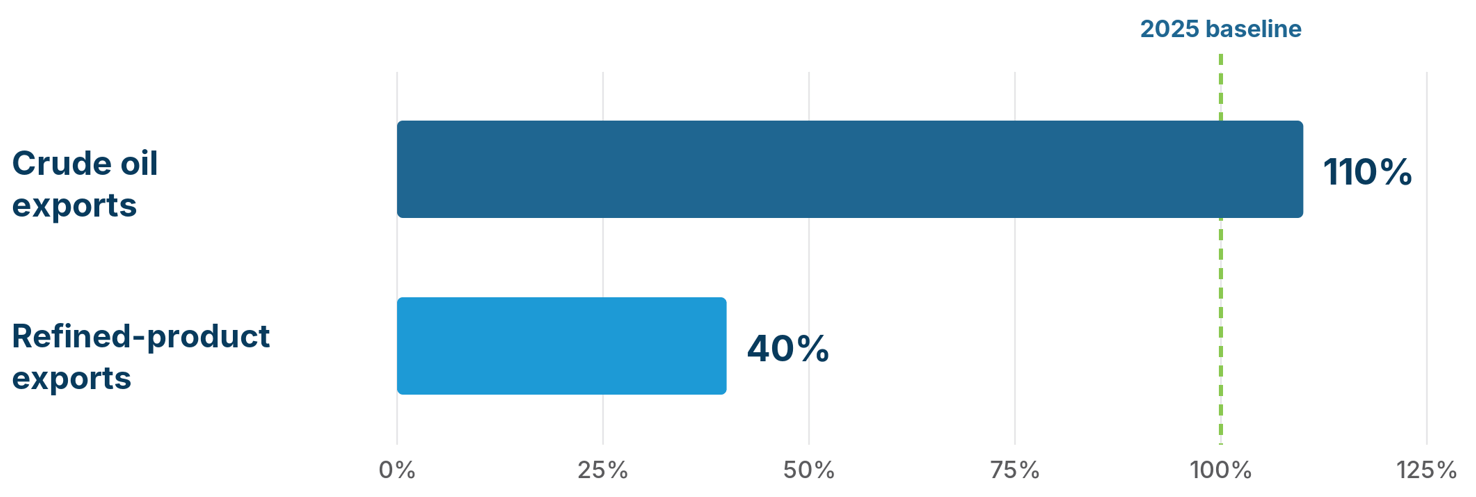
Persian Gulf crude and refined-product exports as percentages of their respective 2025 averages; these are relative indices, not absolute shipment volumes. Illustration based on Goldman Sachs Exchanges, October 23, 2026.
When diesel and jet fuel margins rise, refiners may shift some production toward those higher-margin products, tightening gasoline availability, leading to higher prices. Analysts measure these pressures using “crack spreads,” the difference between crude prices and wholesale refined-fuel prices. Elevated spreads indicate that the price of gasoline or diesel is being driven partly by constraints after crude oil reaches the refinery.6
Low Inventories Magnify Price Shocks
Inventories ordinarily cushion interruptions in production or transportation. Earlier disruptions drew down crude and refined-product stocks, leaving less flexibility to absorb another supply shock. Rebuilding these buffers requires sustained supplies and sufficient refining output, so improving crude shipments may not immediately ease tightness in finished-fuel markets.
For the week ending October 16, 2026, the EIA reported that U.S. commercial crude inventories were approximately 3% below the five-year seasonal average, gasoline inventories were 5% below, and distillate inventories were 9% below (the distillate category includes diesel fuel and heating oil).7
Figure 2: U.S. Inventory Shortfalls Versus the Five-Year Seasonal Average
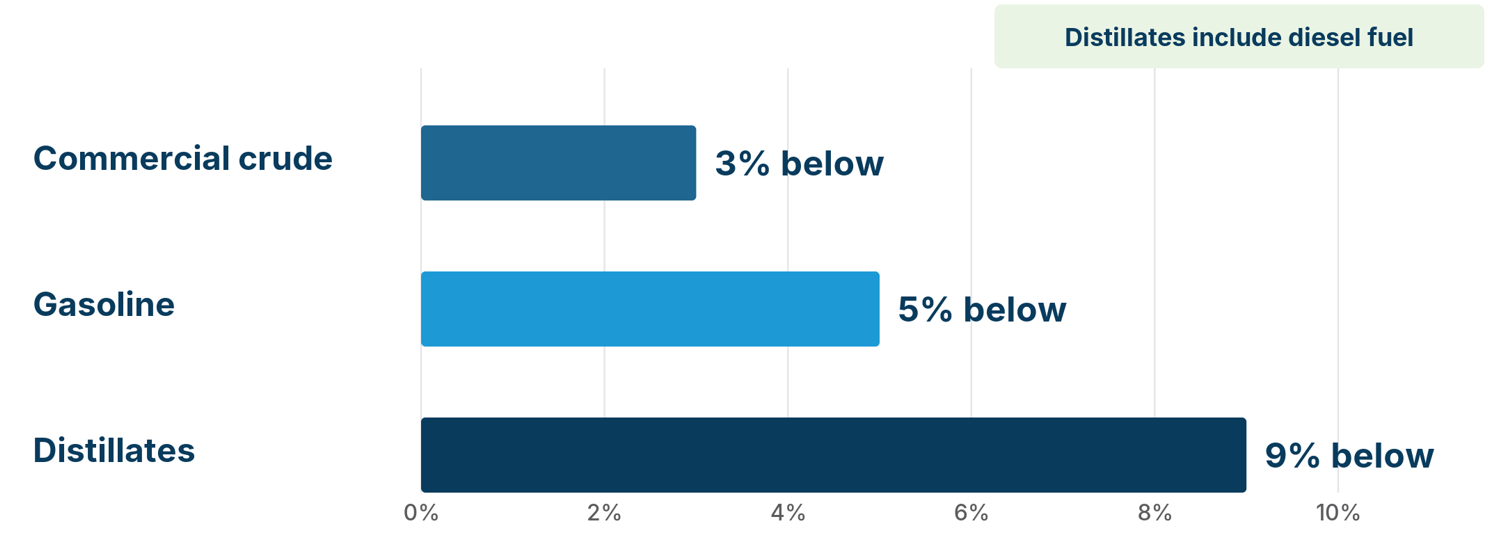
U.S. inventory shortfalls relative to five-year seasonal averages, week ended October 16, 2026. Illustration based on EIA Weekly Petroleum Status Report.
Low inventories increase the impact of any new disruption. They also give importers and refiners an incentive to secure barrels earlier. Restocking can take time when global refining capacity remains constrained, especially for diesel.
Tanker Costs Raise Delivered Prices Unevenly
Conflict-related risks have increased insurance premiums for ships operating near the Middle East. Longer routes, ship-to-ship transfers, and interrupted vessel availability also make the transportation network less efficient.
Goldman Sachs estimated that average global crude freight costs rose approximately $20 per barrel over the preceding year. It attributed roughly three-quarters of the increase to supply-chain reorganization, inefficient tanker use, and heightened shipping risk; the remaining quarter reflected higher marine fuel costs. This is a year-over-year estimate, not an increase confined to the last 30 days.8
These freight costs do not affect every region equally. Goldman Sachs noted that Asian refiners reliant on distant Middle East supplies face a greater direct burden, whereas North American refiners benefit from proximity to local crude production. Higher freight costs can therefore raise delivered crude and finished-fuel prices without increasing costs uniformly across markets.
Financial Hedging Can Amplify Crude-Price Moves
Commodity markets respond to expectations as well as current physical availability. Refiners may buy crude ahead of another possible disruption, while investors may increase oil exposure to hedge against energy-price shocks. Goldman Sachs identified both as contributors to the strength in crude prices in October. These financial and precautionary purchases affect crude pricing, while refinery outages and low product inventories directly constrain the availability of finished fuels.9
What Would Bring Diesel and Gasoline Prices Down?
A sustained easing of geopolitical tensions could improve confidence in crude shipments and reduce the risk premium embedded in current oil prices. Greater reliability along existing export routes could also reduce shipping uncertainty, while new bypass pipeline capacity could improve resilience over time rather than provide immediate relief. Even if crude prices fall, consumers may see only partial relief while damaged refineries remain offline or refined-fuel inventories remain depleted.
Figure 3: Four Pinch Points Between an Oil Well and the Pump

There are four constraints between crude production and finished-fuel delivery. Conceptual illustration based on EIA, Goldman Sachs, and the Federal Reserve Bank of Dallas.
A sustained recovery in retail fuel prices will depend on:
- Restored refinery production
- Normalization of refined-product exports
- Rebuilding of inventories10
Business Implications Extend Beyond the Fuel Pump
Diesel is a significant expense for trucking, agriculture, construction, mining, and industrial businesses. Higher fuel costs can compress margins, increase working capital requirements, or be passed through in higher prices, depending on contracts and competitive conditions. Gasoline prices directly affect household budgets and discretionary spending.
Businesses with substantial fuel exposure may respond by adjusting pricing, improving fleet efficiency, renegotiating transportation terms, or revisiting capital spending plans. The appropriate response depends on how long elevated prices persist.
Petroleum supply security depends on the entire supply chain, from crude production to finished-fuel delivery. Crude exports have improved, but constraints on refining, transportation, and inventories continue to limit the supply of gasoline and diesel. Key indicators to monitor include Persian Gulf refined-product exports, refinery operating capacity, EIA distillate stocks, refining crack spreads, and tanker freight rates. Until these bottlenecks ease, pump prices may remain elevated even if crude availability continues to recover.
- U.S. Energy Information Administration (EIA), Gasoline and Diesel Fuel Update, released October 27, 2026. National retail prices for October 26: regular gasoline $4.269/gal; on-highway diesel $6.352/gal.
- The Irish Times, “Global crude oil prices surge to highest level since May amid Middle East attacks,” October 23, 2026; EIA, October 2026 Short-Term Energy Outlook, Global Oil Markets.
- Goldman Sachs, “Why Oil Prices Are Surging Despite Recovering Supply,” Goldman Sachs Exchanges, October 23, 2026. Daan Struyven estimated a roughly $27/bbl Brent geopolitical risk premium; this is a model-based estimate.
- Jesse Thompson and Garrett Golding, “Refinery Outages Pumping Up Fuel Prices More Than Cost of Crude Oil,” Federal Reserve Bank of Dallas, October 8, 2026. Estimate: 6 million to 8 million barrels/day of curtailed effective refining capacity, up to 10% of global capacity.
- Goldman Sachs Exchanges, October 23, 2026. Estimated Persian Gulf crude exports at 110% and refined-product exports at 40% of their respective 2025 average levels.
- Federal Reserve Bank of Dallas, October 8, 2026, discussion of elevated gasoline, diesel, and jet-fuel crack spreads; Goldman Sachs Exchanges, October 23, 2026, discussion of refinery switching incentives.
- EIA, Weekly Petroleum Status Report, released October 21, 2026, for the week ended October 16. The five-year seasonal-average shortfalls cited here are approximately 3% (commercial crude), 5% (gasoline), and 9% (distillates).
- Goldman Sachs Exchanges, October 23, 2026. Estimated global average crude freight costs up approximately $20/bbl year over year; three-quarters reflected supply-chain reorganization and shipping risk, and one-quarter reflected marine fuel costs. Direct regional effects vary.
- Goldman Sachs Exchanges, October 23, 2026, discussion of precautionary refiners’ purchases and investors hedging exposure to further increases in oil prices.
- EIA, October 2026 Short-Term Energy Outlook; Federal Reserve Bank of Dallas, October 8, 2026. Forward-looking discussion is an analytical synthesis, not a guaranteed price forecast.