Italiano



Although the Iran conflict has been dominating recent news cycles, the Russia-Ukraine war continues and is also impacting U.S. financial markets. The connection between a Ukrainian drone strike on a Russian refinery and U.S. interest rates may seem remote, but it isn’t. Ukraine’s campaign against Russian refining capacity is tightening global supplies of diesel, gasoline, and jet fuel. That pressure is showing up in refining margins and ultimately U.S. energy prices, complicating the Federal Reserve’s effort to bring inflation back to target.
A recent RBN Energy analysis,1 “Rock Bottom – Declining Russian Refinery Output Pushing Global Products Prices Higher, Shifting Trade Flows,” lays out a fundamentals story that deserves more attention than it has gotten: Russia’s refining sector has been losing significant capacity for months, and the resulting shortage of diesel, gasoline, and jet fuel is now a measurable input into the U.S. inflation and interest rate outlook.
What Is Happening in Russia
Ukraine’s drone campaign has moved from occasional strikes on individual plants to a sustained, systematic effort to take Russian refining capacity offline. Ukrainian forces have hit at least 24 of Russia’s 34 large refineries in roughly 50 attacks over the past several months, including a July strike on the Omsk refinery, the country’s largest, which had previously sat far enough from the front line to be considered safe.2 The number and impact of these strikes is illustrated on the map below:3
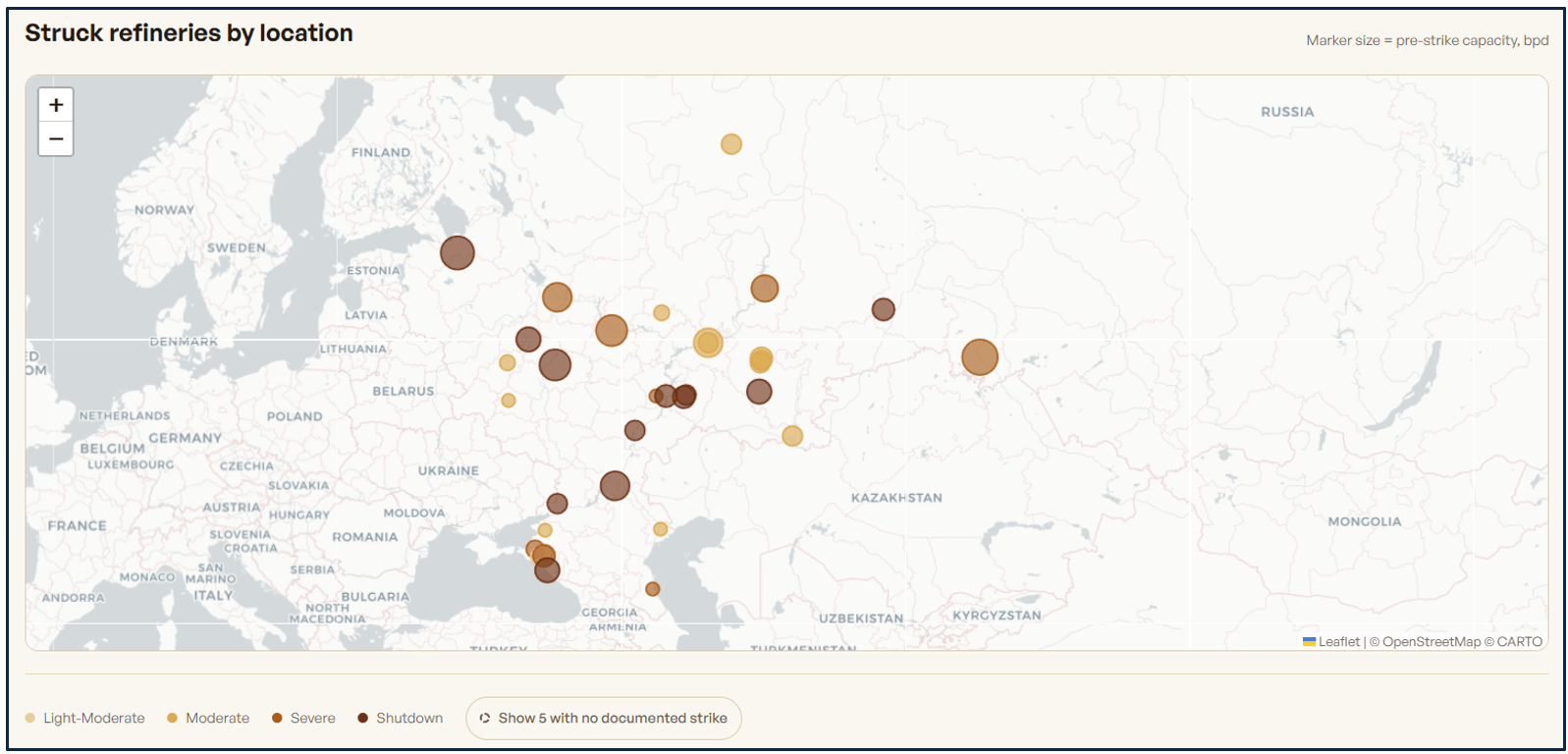
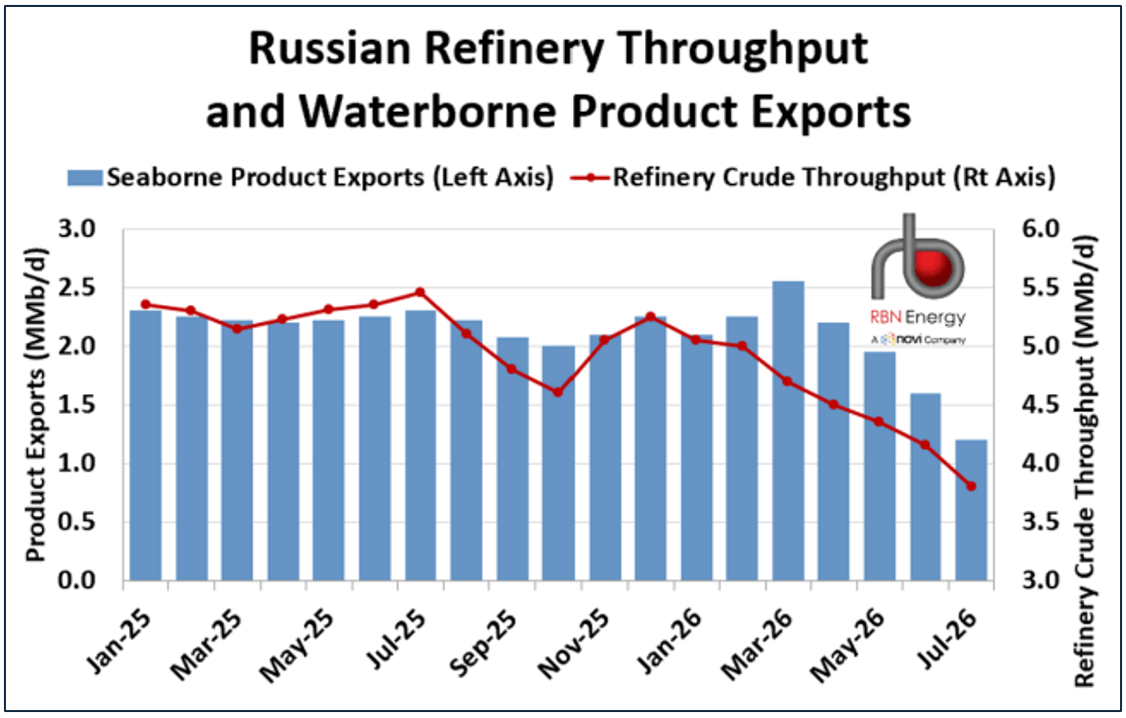
Russian crude-processing rates fell to an estimated 3.6 to 3.9 million barrels a day in July, the lowest level since 2002 and more than 1.4 million barrels a day below the prior year’s average.4 Facilities representing close to a quarter of Russia’s total refining capacity have either halted operations or are running well below normal. This year’s significant decline in Russian refinery throughput and exports are shown in the following chart:5
The response inside Russia has been to ration. Moscow has banned exports of gasoline, diesel, and jet fuel at various points this year to keep barrels at home, a step that removes a significant, historically reliable supplier from the seaborne products market. Export customers in Europe, Africa, and Asia who built supply chains around Russian diesel have had to look elsewhere, and they are competing for the same barrels as everyone else.
Why does a refinery outage in Russia matter to U.S. fuel prices? Refined fuels trade in a global market. When diesel becomes scarce and more valuable overseas, international buyers compete for available barrels, including supplies from U.S. Gulf Coast refiners. That competition can pull product toward higher-priced export markets and force U.S. buyers to compete against global prices.
The “3-2-1 Crack Spread”
The crack spread is a shorthand measure of the value created by turning crude oil into finished fuels such as gasoline and diesel. The “3-2-1” convention assumes three barrels of crude are converted into two barrels of gasoline and one barrel of distillate. It is a gross processing-margin indicator, not refinery profit, but it is a useful signal of how scarce refining capacity has become.
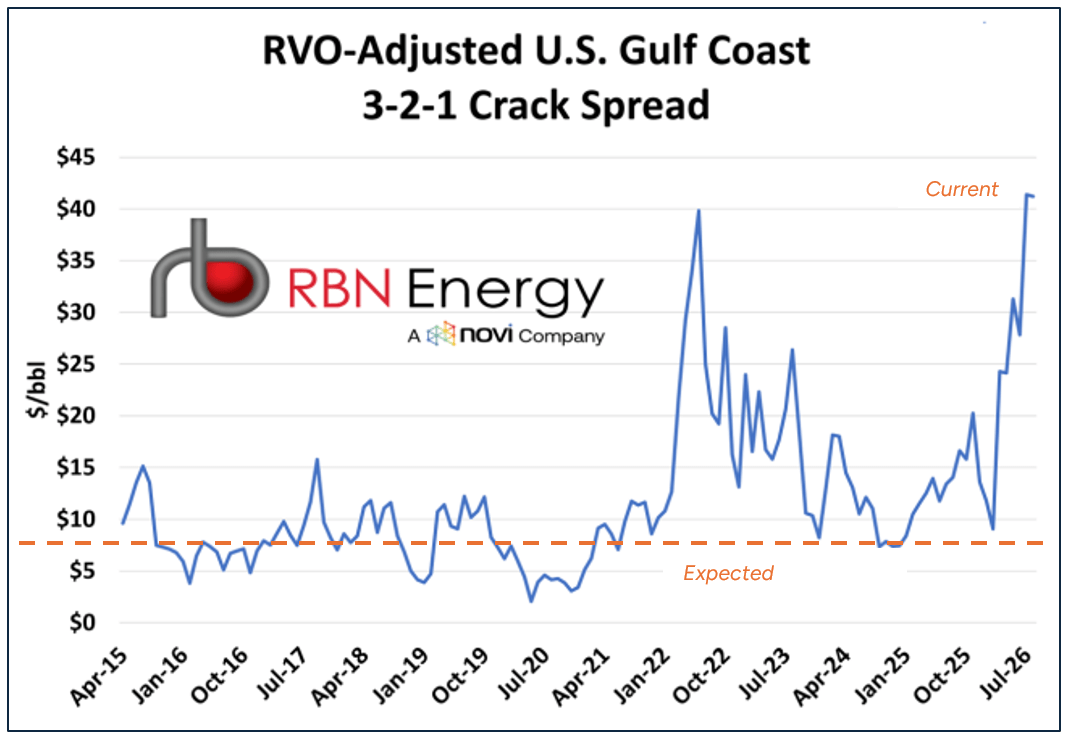
As shown in the chart above,6 this metric historically has been in the range of $5.00 to $15.00, but it is currently above $40.00. When crack spreads spike, the constraint is refining capacity, not crude oil supply.
Why Global Product Shortages Matter in the U.S.
Russia’s refining outages have not occurred in isolation. Around the same time, disruption to Persian Gulf shipping and refinery damage tied to the U.S.-Iran conflict cut Persian Gulf product exports by more than 2 million barrels a day, concentrated in the same diesel, jet fuel, and gasoline categories Russia used to supply.
Add in Chinese export restrictions, a multi-year wave of permanent refinery closures in Europe and North America, and limited near-term additions to global refining capacity capable of offsetting these disruptions, and the result is a tight global refined-products market layered on top of elevated crude prices. Crude oil and refined products do not always move together, and this year they have not. Crude has been volatile but has spent long stretches below its spring 2026 peak. Refining margins, the crack spread between crude and finished products, have stayed elevated because the bottleneck is the refining capacity required to turn crude into fuel.
Some Russian crude that is not processed domestically can still move into export markets, but that does not fully replace the lost supply of finished fuels. The relevant bottleneck is the global system’s available refining capacity, configuration, and logistics — the ability to turn crude into the specific products consumers need, where they need them.
The U.S. Energy Information Administration’s August Short-Term Energy Outlook makes the same point directly, attributing the recent rise in U.S. refinery margins to lower Russian product exports, the Strait of Hormuz disruption, and reduced Chinese refining activity.7
Duration matters. A short-lived refinery outage can create a temporary price spike; a sustained loss of capacity is more consequential. The key question is how quickly damaged Russian facilities return to service, and whether additional strikes continue to offset repairs.
From Fuel Prices to Fed Policy
U.S. consumer prices are impacted by gasoline and other energy components of the CPI. July’s report showed headline CPI up 3.4% year over year, with gasoline still up 24.6% and the broader energy index up 14.7%, even though both had eased from their spring peaks. The EIA expects U.S. refinery inputs to remain around 17 MMb/d through August, then fall below 16 MMb/d in October as seasonal maintenance begins. That decline would reflect the turnaround calendar, not refiners walking away from strong margins. With inventories already thin, routine autumn maintenance could tighten the balance further.
Core CPI, which strips out food and energy, sat at 2.5%, still above the Fed’s 2% target on its own. The Fed does not target headline CPI, but persistent energy shocks can affect transportation costs, production costs, inflation expectations, and second-round pricing behavior. Higher diesel prices raise the cost of moving nearly every physical good in the U.S. economy, and that cost eventually impacts core goods prices.8
This is the dynamic the Fed has been wrestling with since the spring. At its July meeting, the FOMC held the federal funds rate at 3.50% to 3.75% for a fifth straight meeting, but the vote was 9-3, with three regional bank presidents dissenting in favor of an immediate quarter-point hike. The committee’s statement pointed specifically to “supply shocks that have driven price increases in certain sectors, including energy” as a reason inflation remains above target.9 Continued high commodity prices and refinery constraints could therefore become an additional headwind to future interest-rate reductions.
The Fed Does Not Have to Raise Rates for This to Matter
The transmission can occur before the FOMC changes its target rate. If persistent energy inflation causes investors to expect fewer or later rate cuts, Treasury yields and other market borrowing rates can reprice accordingly. Financing conditions can therefore tighten even if the Fed simply holds rates steady.
Why This Matters for Management and Investors
Higher-for-longer interest rates affect borrowing costs, acquisition financing, refinancing decisions, capital spending, and the discount rates investors use to value future cash flows. At the same time, companies with significant transportation, logistics, or energy inputs can face pressure on operating margins. For investors, attorneys, and company owners, the issue is therefore broader than the price at the pump: a persistent refining shock can influence both operating performance and the cost of capital.
This is how a $55,000 Ukrainian drone10 aimed at a Russian refinery can ultimately affect the cost of capital in the United States.
Monthly WTI Price Review
Spot and futures prices for the West Texas Intermediate (WTI) contract increased by more than $19.92 per barrel11 in the near term, an approximate one standard deviation increase given previous expectations that the war with Iran was coming to an end.12
In June, WTI oil prices per barrel fell into the $70s after the cease-fire with Iran was announced. However, subsequent Iranian attacks on commercial vessels, renewed U.S. military action, and tighter restrictions on Iranian crude exports reignited concerns about reliable tanker traffic through the Strait of Hormuz.
Volatility persisted through July, August, and early September. The EIA reported that crude prices rose in August as Middle Eastern exports remained constrained, citing the renewed U.S. blockade of Iranian oil exports, additional sanctions, and disruptions to regional shipping routes.13 Escalating tanker attacks subsequently pushed WTI above $100 per barrel on September 10, and attacks on Saudi Arabia’s East-West pipeline forced a temporary shutdown of a key alternative export route that bypasses the Strait of Hormuz.14
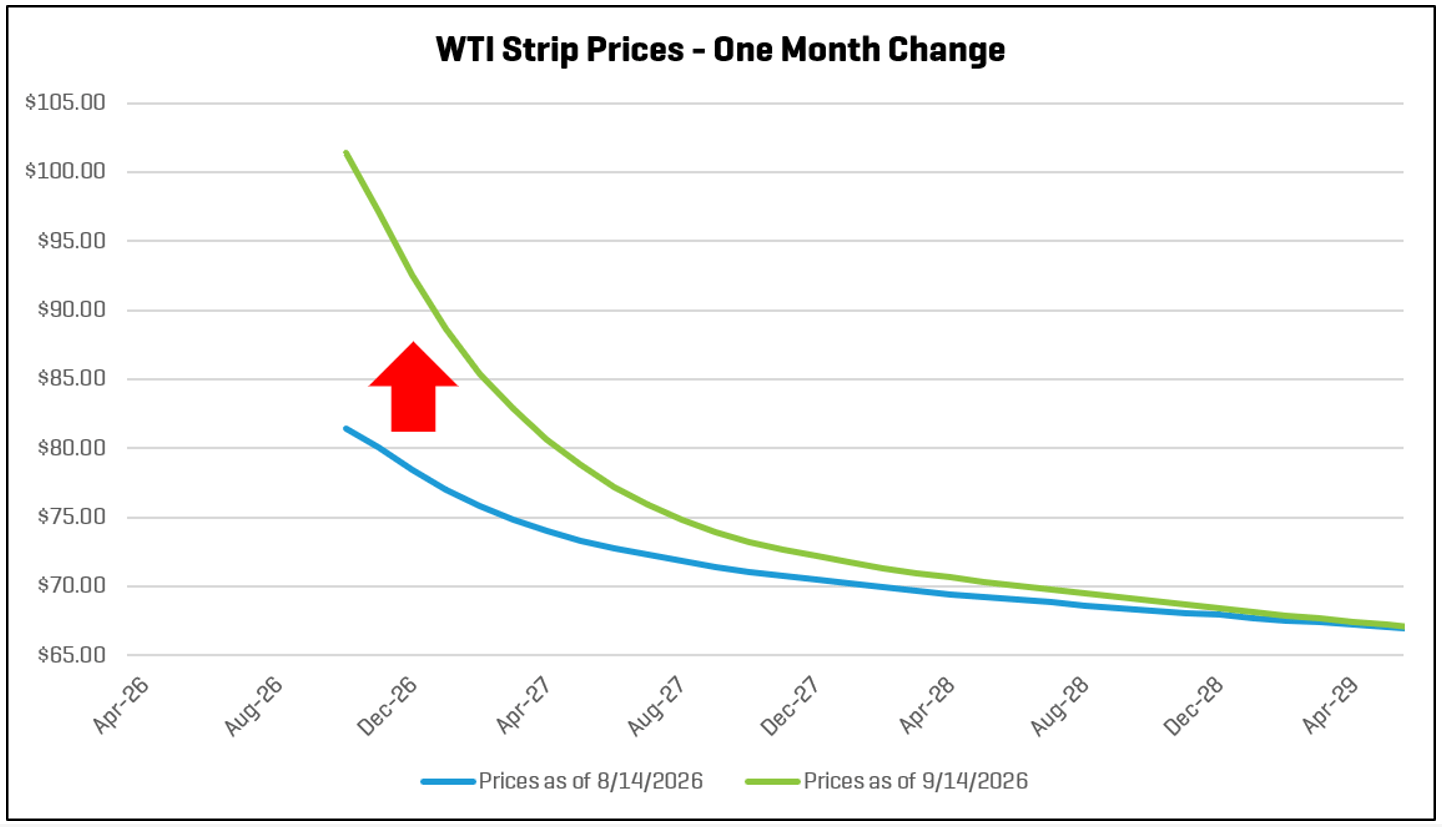
The curve remains in backwardation, indicating that the market expects future spot prices to be lower than near-term prices.
Oil Price Outlook
The price distribution below show the crude oil spot price on September 15, 2026, together with predicted future prices based on options and futures markets. Light blue lines represent outcomes within one standard deviation (1σ) of the mean; dark blue lines represent outcomes within two standard deviations (2σ).
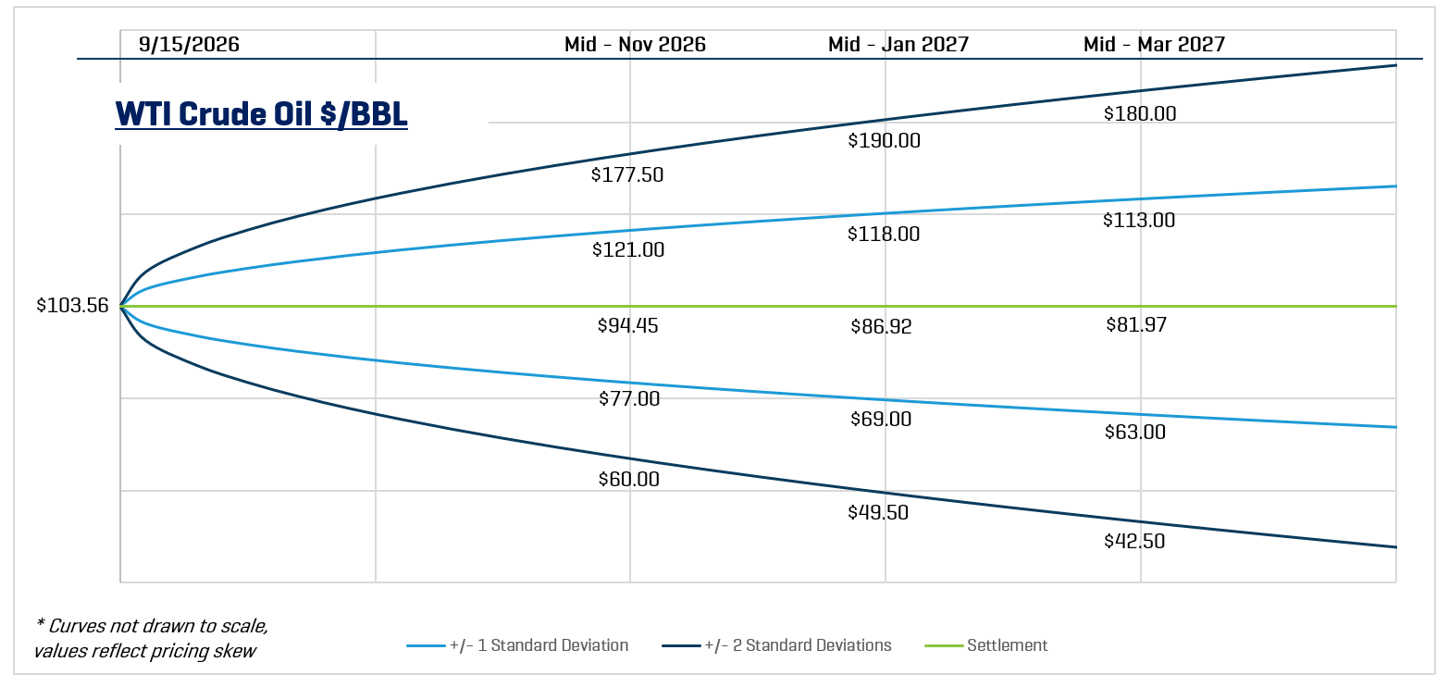
Based on these prices, the market indicated a 68% chance that oil would trade between $77.00 and $121.00 per barrel in mid-November 2026, between $69.00 and $118.00 per barrel in mid-January 2027, and between $63.00 and $113.00 per barrel in mid-March 2027. It also indicated a 95% chance of a range between $60.00 and $177.50 per barrel in mid-November 2026, between $49.50 and $190.00 per barrel in mid-January 2027, and between $42.50 and $180.00 per barrel in mid-March 2027.
Market Implications
Option prices and models reflect expected probabilities, not certain outcomes. They nevertheless remain useful tools for assessing market expectations and risk.
For mid-March 2027 pricing as of September 15, 2026, the 1σ range spanned $50.00 per barrel, while the 2σ range spanned $137.50 per barrel. Compared with the mid-February 2027 forecast from a month earlier, the 1σ range widened by $3.50 per barrel, while the 2σ range narrowed by $7.50 per barrel. This suggests a modest reshaping of the distribution, with greater dispersion around the central price range but tighter pricing of extreme outcomes in the tails.
- RBN Energy, “Rock Bottom – Declining Russian Refinery Output Pushing Global Products Prices Higher, Shifting Trade Flows,” rbnenergy.com.
- Julianne Geiger, “As Ukraine Cripples Russian Refining, Global Diesel Markets Pay the Price,” OilPrice.com, July 15, 2026.
- The Refinery Ledger, https://ukrdronecampaign.pplx.app/#hero.
- “Russian Refinery Runs Plunge to Lowest in More Than Two Decades,” Bloomberg, July 13, 2026; “Russian Oil Refining Falls to 24-Year Low After Ukrainian Drone Strikes,” The Moscow Times, August 3, 2026 (citing Bloomberg and EA Analytics data).
- Jason Lindquist, “Rock Bottom – Declining Russian Refinery Output Pushing Global Products Prices Higher, Shifting Trade Flows,” RBN Energy, August 19, 2026.
- Ibid.
- U.S. Energy Information Administration, Short-Term Energy Outlook, August 2026.
- “Basket Case – With U.S. Refiners Already Running Hard, Relief on Diesel Remains Elusive,” RBN Energy, September 14, 2026.
- Board of Governors of the Federal Reserve System, FOMC Statement, July 29, 2026.
- Tamika Johnson, “Why Russia Can’t Stop Ukraine’s Drones,” Afterburner, MiGFLUG, June 23, 2026.
- Versus August 14, 2026.
- Ibid.
- U.S. Energy Information Administration (EIA), Short-Term Energy Outlook, September 9, 2026.
- Saudi Press Agency, “East–West Pipeline Shut Down as a Precaution Following Multiple Attacks,” September 11, 2026.