Deutsch



On September 16, 2026, the Federal Reserve raised its target range for the federal funds rate by 25 basis points, from 3.50–3.75% to 3.75–4.00%. The Fed’s stated rationale included the elevated inflation rate and the intention to support a return to its 2% inflation objective.1
Today’s inflation picture is unusually energy heavy. Consumer prices were up 3.4% over the twelve months through August, but prices excluding food and energy rose only 2.4%. Energy prices rose 16.3%, including a 27.4% increase in gasoline. In August alone, gasoline accounted for more than one-third of the increase in the overall Consumer Price Index (CPI).
There is nothing unusual about that response. Fighting inflation is part of the Fed’s mandate, and interest rates are one of its principal tools. Interest rates work on the demand side of the market, while today’s price pressure has both demand and supply components.
Competitive Markets Set Oil and Diesel Prices
Market prices for oil and related refined products (diesel and gasoline) are the result of the clearing prices necessary to balance supply and demand. As demand increases, prices increase. Likewise, as supply increases, prices decrease.
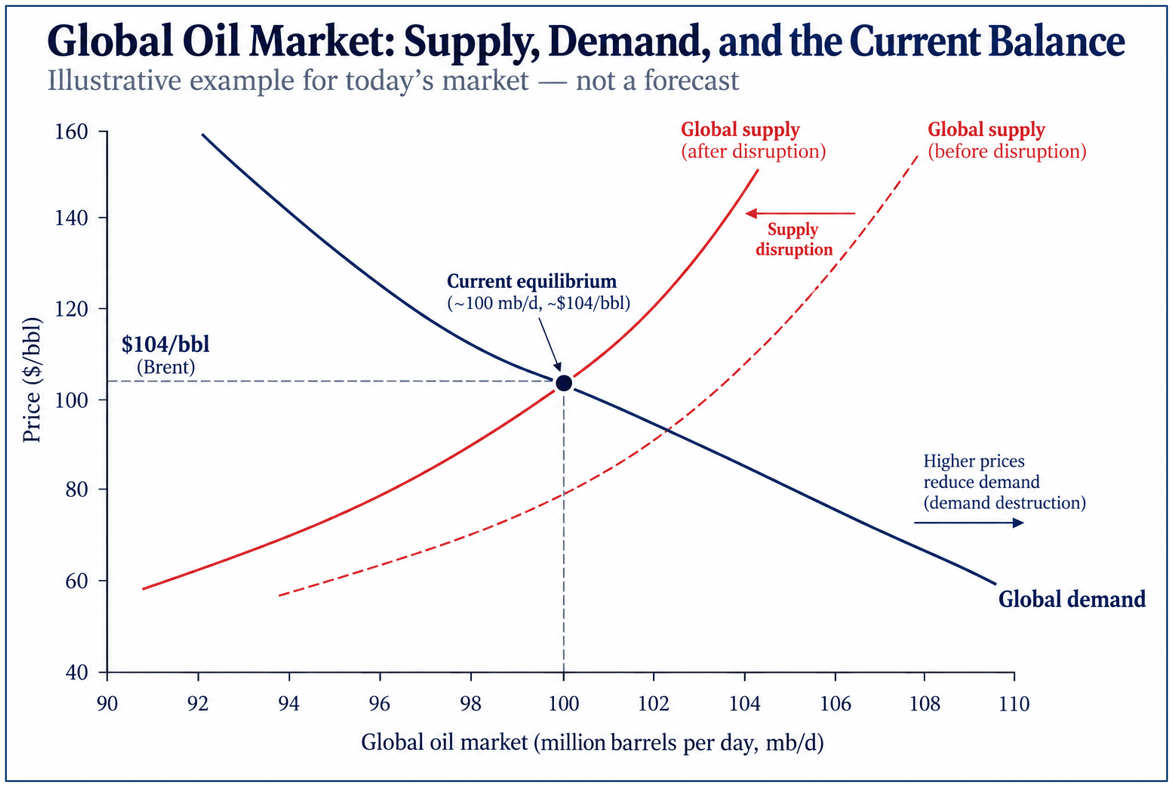
Higher interest rates can reduce inflation. Higher rates work by moderating demand across the economy. Today, an important source of price pressure is limited physical supply, which rates affect only indirectly. Diesel prices provide a clear illustration.
What Higher Interest Rates Actually Do
The Fed does not raise interest rates because higher rates somehow cause diesel prices to decline. The relationship is much more indirect:
Higher rates → higher borrowing costs → less consumption and investment → less freight, construction and industrial activity → lower petroleum demand → softer crude oil and diesel markets → eventually, lower fuel prices.
Diesel demand is particularly sensitive to economic activity because diesel powers much of the equipment that supports the economy: trucks, agricultural equipment, construction machinery, and industrial equipment.
Higher mortgage rates can reduce new construction, and higher corporate borrowing costs can discourage new capital investment. Eventually, this is expected to result in fewer truck miles and lower diesel consumption. That is the demand-side transmission mechanism.
The same mechanism can work through crude oil prices. If tighter financial conditions reduce expectations for economic growth and petroleum consumption, crude prices will fall. Because crude oil historically represents the largest component of the retail diesel price — about 51% on average from 2004 through 2025 — that can eventually translate into lower prices at the pump.2
So there exists sound economic logic to the demand-side channel, although its effect on diesel prices is also shaped by the supply conditions.
Today’s High Diesel Prices Reflect an Unusually Tight Supply Picture
The national average retail diesel price reached $6.529 per gallon for the week of September 21, 2026. Why? The U.S. Energy Information Administration (EIA) describes diesel prices as the combination of crude-oil costs, refining costs and margins, distribution and retail costs, and taxes.
The EIA says the recent surge has been driven by both elevated crude prices and tight global supplies of distillate fuel oil.3 Although U.S. diesel production has been strong, today the United States is participating in a global refined-products market that has become unusually constrained.
The pressure is coming from several directions simultaneously. Global distillate production has been disrupted, international flows are constrained, U.S. inventories are low, domestic refineries have been running near their physical limits, and high international prices are pulling U.S. barrels into export markets. EIA’s September Short-Term Energy Outlook describes tight global distillate markets, high U.S. net exports, and low inventories as central factors behind elevated diesel prices.4
These are not primarily monetary phenomena, but physical constraints.
Two Sides of the Diesel Market
Imagine a simplified diesel market in equilibrium: 100 barrels supplied = 100 barrels demanded.
Now suppose geopolitical disruptions remove 10 barrels of supply: 90 barrels supplied does not equal 100 barrels demanded.
Therefore, prices rise. And notably, monetary policy does not act directly on physical supply factors such as refinery throughput, shipping lanes, pipeline capacity, or inventories. Instead, monetary policy works by moderating demand until the market rebalances: 90 barrels supplied = 90 barrels demanded.
That is the fundamental tradeoff. Higher interest rates address an energy shortage from the demand side. Equilibrium can also be restored from the supply side, through added supply or fewer constraints.
Understanding the Physical Bottlenecks in the Energy Value Chain
Since a large part of the current high inflation rate is driven by energy prices, policymakers could be asking not only how to suppress demand, but also how to increase supply. That means examining the entire energy value chain between an oil well and the end consumer of refined petroleum products.

This does not mean that any single policy change or infrastructure project would suddenly return diesel to $3.50 per gallon. Today’s diesel shortage is global, and some of its most important causes lie outside U.S. control. It does suggest that supply-side constraints also deserve attention.
U.S. Refining Capacity
National refinery utilization was 96.8% for the week ending September 11 before falling to 94.0% the following week as seasonal (summer) maintenance began; in the Midwest, refinery utilization fell to 89.0%. Those utilization rates represent nearly “optimal” output rates, and expanding physical refining capacity takes considerably more time and capital investment. In other words, there is not enough refining capacity or margin that refiners can simply turn a dial and producing substantially more diesel.5
Inflation Can Be Fought With Both Supply and Demand Responses
As diesel prices rise, trucking becomes more expensive. More expensive freight raises the cost of delivered goods, and businesses would be expected to pass those costs to customers. Likewise, workers may seek higher wages to compensate for higher living expenses. As those dynamics become embedded into the economy, a temporary energy shock can contribute to broader and more persistent inflation.
There are two very different ways of bringing an overheated diesel market back toward equilibrium. One is to reduce demand. The other is to increase supply. The Federal Reserve has tools for the first. Many participants, from private industry to public policymakers, influence supply conditions.
None of this suggests that the Federal Reserve should ignore inflation or abandon its price-stability objective. Nor does it mean that additional energy supply can magically appear overnight. Refining capacity, infrastructure, and global energy flows are complex, and many of the forces affecting today’s diesel market are beyond the control of any single institution.
When inflation is driven primarily by excess demand, higher interest rates are a logical response. But when a meaningful portion of inflation is being driven by shortages of crude oil, refining capacity, inventories, or other physical constraints, reducing demand is only one way to restore balance. Increasing supply, where practical, is another. Monetary policy will always have an important role in controlling inflation. But interest rates are a broad tool: they work by making borrowing more expensive and ultimately slowing activity throughout the economy. Rate changes influence demand for diesel, while supply depends on production, refining and logistics.
Because today’s inflation has both demand and supply components, understanding both sides gives a fuller view of the price outlook.
- Federal Reserve Board, “Federal Reserve issues FOMC statement,” Sept. 16, 2026.
- U.S. Energy Information Administration (EIA), “Factors affecting diesel prices,” accessed Sept. 26, 2026.
- EIA, “What goes into diesel prices?” Sept. 18, 2026.
- EIA, Short-Term Energy Outlook, Sept. 2026, p. 6.
- EIA, “Refinery Operable Capacity Percent Utilization,” released Sept. 23, 2026.