Italiano



The first half of 2026 built meaningfully onto the last year’s momentum with SpaceX’s June listing being the headline event. SPAC issuance has continued to accelerate, reaching its highest level since 2021. Macro headwinds have not disappeared, but the breadth and conviction of this year’s issuance activity suggest the market has moved past tentative reopening and into something more durable.
This article discusses how the U.S. public markets performed in 1H 2026 and what it signals for the months ahead.
IPOs by Volume and Value
The U.S. IPO market activity accelerated meaningfully in the first half, even as persistent inflation concerns and lingering trade-policy friction kept investors selective. The U.S. markets saw 186 IPOs price through June 30, up 12% compared to the same window a year earlier. February was the busiest single month with 40 listings while March briefly cooled to 16. Deal flow picked up strongly through April, May, and June. The first half pace would put 2026 on track for a third straight year of growth, following 347 IPOs in 2025 and 225 in 2024.
The rebound becomes even more obvious when measured by capital raised. Gross proceeds in the first half reached $134.2 billion, more than five times the $25.4 billion raised in the same period last year. While SpaceX’s $75 billion IPO accounted for a significant share of the increase, the broader market remained notably stronger even after excluding the deal. Excluding that transaction, issuers still raised $59.2 billion, more than 2x of the capital generated in 1H25, a reflection of increasingly mature cohort of companies tapping the public markets.
Figure 1: No. of U.S. IPOs Since 2001
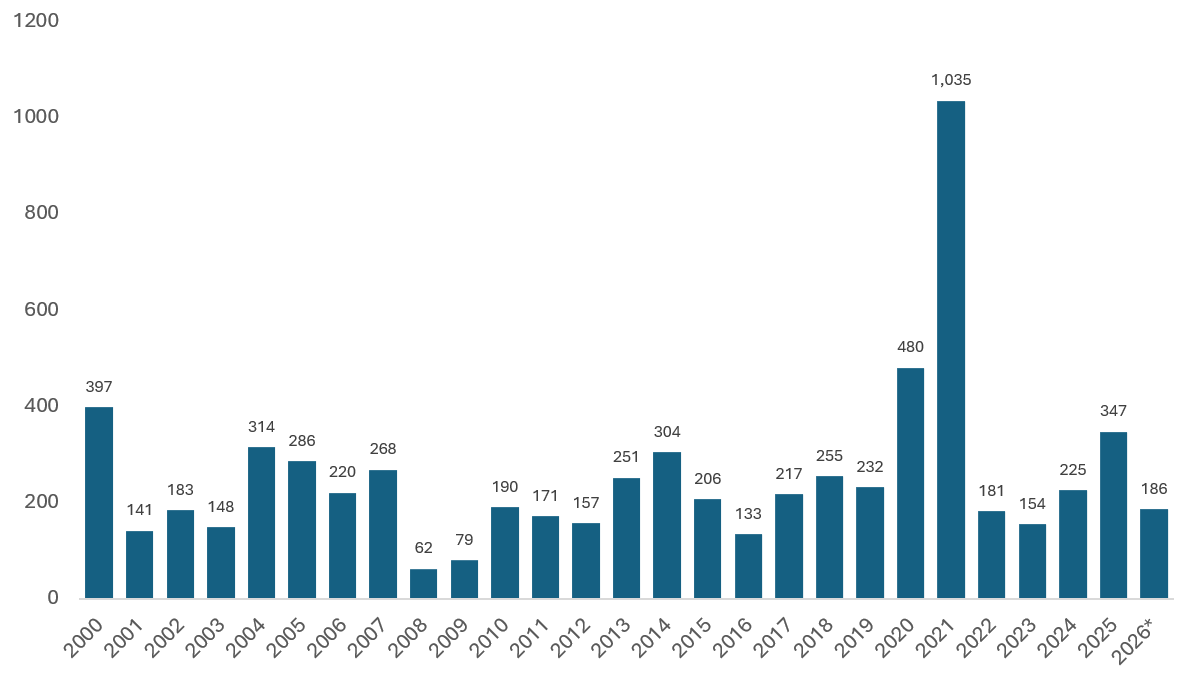
Source: Stock Analysis. Note: 2026 data is as of June 30.
IPOs by Industry
The chart below shows IPO count by industry for the first half of 2026.
Figure 2: No. of IPOs by Industry Classification
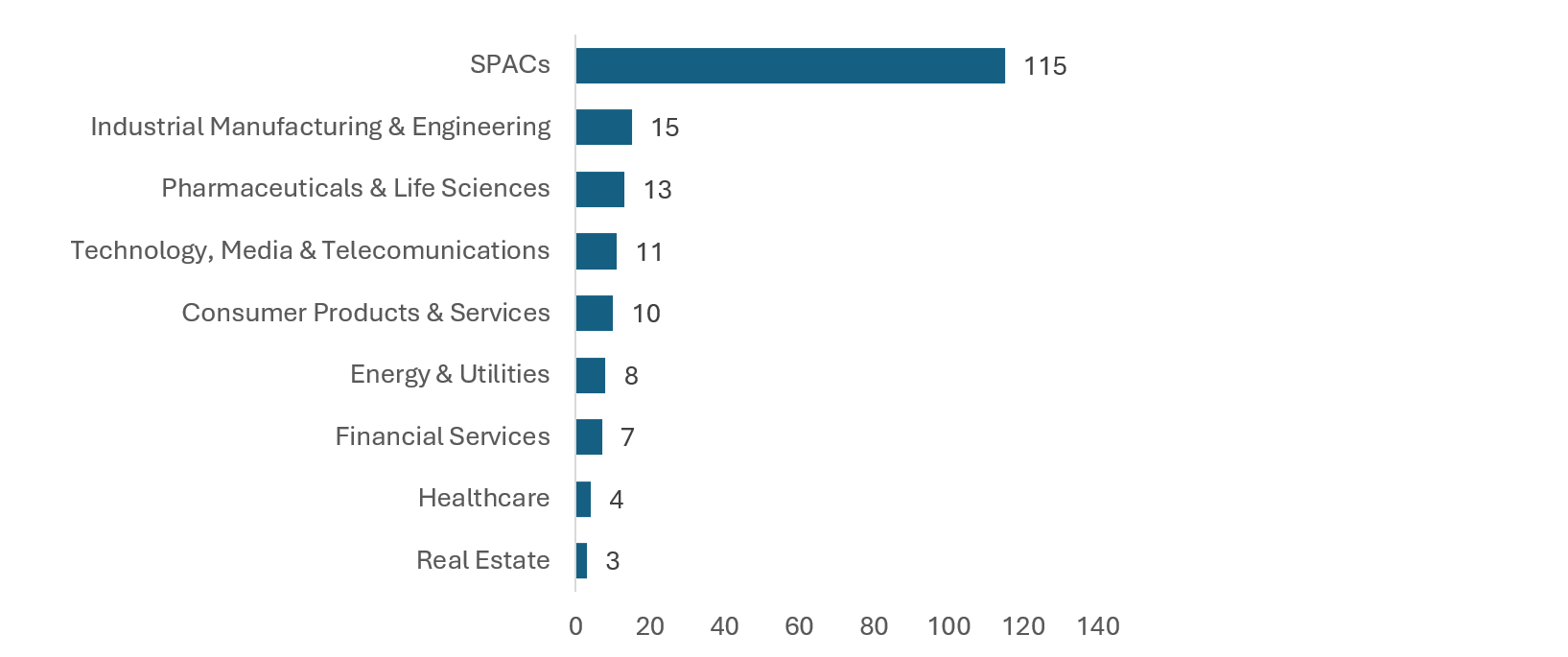
Source: Stock Analysis
Industrial, Manufacturing, & Engineering (IME)
IME companies saw 15 listings in 1H 2026, representing roughly 8% of total IPO activity and commanding an outsized share of capital with $87.7 billion in proceeds. Aerospace and defense accounted for more than half of all sector deals, reflecting both the strength of current demand and a structural shift in how investors are approaching the space.
SpaceX’s debut has reset expectations across the sector. Its influence is now visible in how investors price assets across launch, satellite communications, autonomy, missile defense, and defense-adjacent AI. Companies are moving quickly to capitalize on strong investor appetite, abundant capital, and premium valuations for differentiated next-generation aerospace and defense assets. Global conflicts have added urgency to this dynamic with the Pentagon actively diversifying its contractor base, creating openings for newer entrants.
Electrical equipment and power solutions also had a strong first half, benefiting from surging capital demand tied to AI data center buildout and energy infrastructure expansion.
Looking ahead, aerospace and defense is likely to remain the biggest contributor of IME IPOs. Defense funding commitments and sustained commercial aerospace demand provide the kind of long-term revenue visibility that public market investors find compelling.
Pharmaceuticals & Life Sciences
Pharmaceuticals & Life Sciences was second most active traditional IPO sectors with 13 listings (all biotech) raising a combined $4.5 billion. That total exceeds what the entire sector raised across all of 2025, when just 18 companies came to market for roughly $2 billion. The deals were concentrated in clinical-stage companies targeting large therapeutic markets.
Still, IPO activity remains small relative to the exits happening across the industry, where M&A is the main route. Biopharma dealmaking reached $106 billion across more than 200 transactions in the first five months of 2026, per Pitchbook. Even as a smaller exit route, the reopening of the IPO window signals that public investors are once again willing to underwrite development-stage risk, provided the science is credible and the clinical data is more mature than past cycles.
Technology, Media, & Telecommunications (TMT)
TMT saw the biggest drop in listing in 1H 2026 compared to 2025, accounting for 11 IPOs and representing only 6% (vs 14% in 2025) of all IPO volume. However, TMT companies raised a combined $9.1 billion, a per-deal average that reflects how selectively the market is rewarding technology issuers. Software application and infrastructure accounted for 9 of those 11 deals.
The AI infrastructure buildout is also beginning to reshape the IPO pipeline with companies like Cerebras already trading in public markets. As hyperscalers continue investing hundreds of billions of dollars into AI infrastructure, companies supplying the software, networking, data, security, and compute layers are reaching the scale required for public markets.
The TMT pipeline going into the second half is the most anticipated in years. Both Anthropic and OpenAI filed confidential S-1s with the SEC in June. Should either (more likely Anthropic) list before year-end, they would rank among the largest technology IPOs ever completed and redefine valuation benchmarks for the entire AI sector. Beyond those two names, a long queue of late-stage, venture-backed companies are watching conditions closely.
Consumer Products & Services (CPS)
CPS was another sector that lagged last year’s pace, with 10 IPOs in the first half. Issuers are contending with a difficult operating backdrop with shifting demographics, the ripple effects of the Middle East conflict, evolving trade policy, and the ongoing technology-driven disruption of traditional retail and consumption models.
Looking ahead, capital is concentrating around must-have assets, businesses with resilient demand, category leadership, stronger customer access, or greater supply chain control. In this window, investors are likely to reward companies with a clear margin-improvement story, whether through automation, supply-chain rationalization, or smarter demand forecasting.
IPO Outlook
After a first half that reset expectations on deal size, investor demand, and sector breadth, the conditions for continued issuance are the best they’ve been in years. The backlog is deep with hundreds of late-stage venture- and sponsor-backed companies, many of them long-overdue unicorns. These companies have been holding back, waiting for exactly this kind of stable, receptive window. Even a partial release of that pent-up supply would push full-year volumes well above the already-strong 2026 total.
The AI mega-IPO storyline will be the dominant narrative of the second half. Anthropic and OpenAI, each privately valued close to $1 trillion, have both filed confidential S-1s, and market chatter increasingly centers on which will list first. The first to price will effectively set the valuation template for the entire AI sector, with reverberations across public markets far beyond technology.
Core inflation has drifted higher on the commodity supply shock tied to the Strait of Hormuz closure, and the Fed is now expected to hold rates at 3.50–3.75% through year-end.1 On July 29, the Fed voted to hold rates at 3.50–3.75%. Higher-for-longer rates will not close the IPO window, but they will keep investors discriminating on valuation and quality.
The real test for the rest of 2026 is whether momentum broadens. The first half proved the market can absorb historic deal sizes. The second half will likely test whether the confidence on display in the first half was a durable shift or a function of unusually favorable conditions.
- Indradip Ghosh, “Fed to hold rates this year, economists say, defying market bets for hikes: Reuters poll,” Reuters, June 26, 2026.