Italiano


In May 2026, the United Arab Emirates (UAE) announced that it would fast-track a second crude oil pipeline parallel to the existing Habshan-Fujairah line, increasing the volume of crude that can reach the Gulf of Oman without passing through the Strait of Hormuz. The project, referred to by state media and industry outlets as the West-East Pipeline, is targeted to become operational in 2027.
Its purpose is straightforward: to give the UAE a larger, more reliable export channel that bypasses a chokepoint through which roughly one-fifth of the world’s petroleum liquids normally flow. From a market perspective, the pipeline is best understood as an infrastructure hedge against a specific geopolitical tail risk. Its effects are likely to emerge gradually, through improved supply confidence and resilience, rather than as an immediate step change in global oil flows.
Overview of the Pipeline
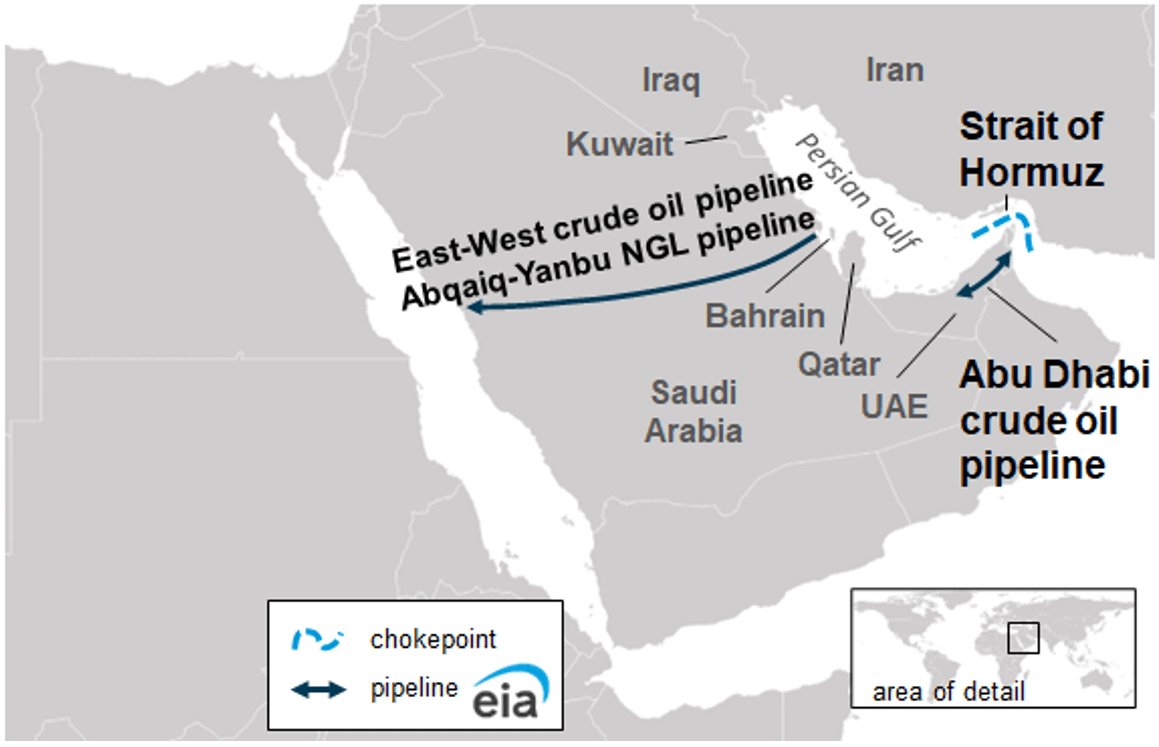
The new line builds on established infrastructure. The existing Abu Dhabi Crude Oil Pipeline (ADCOP), commonly called the Habshan-Fujairah pipeline, is a 48-inch line that runs more than 360 kilometers (roughly 225 miles) from Abu Dhabi’s onshore Habshan fields to the port of Fujairah on the Gulf of Oman. It became fully operational in 2012 and can carry up to 1.8 million barrels per day (bpd), although it typically moves closer to 1.5 million bpd in routine operation.
Figure 1. Regional Oil Transit Routes and Bypass Pipelines Around the Strait of Hormuz
Source: U.S. Energy Information Administration.
The second pipeline is designed to follow the same route from Habshan to Fujairah. State-owned ADNOC, whose board reviewed the expansion plans under the chairmanship of Abu Dhabi’s Crown Prince, expects the project to double export capacity through Fujairah when it comes online in 2027. Industry estimates place combined post-expansion throughput at roughly 3.6 million bpd.1 The Fujairah terminal is supported by substantial storage facilities, reported at about 42 million barrels, reinforcing its role as one of the world’s leading bunkering and oil-storage hubs.2 As of mid-2026, construction was being accelerated to meet the 2027 target, so the doubled capacity remained a near-term expectation rather than a current reality.
Strategic Significance: An Alternative Export Route
The pipeline’s strategic value is geographic. Fujairah sits on the Gulf of Oman, outside the Strait of Hormuz, so crude routed there can be loaded and shipped without transiting the narrow waterway bordered by Iran and Oman. Saudi Arabia and the UAE are the only Gulf Cooperation Council producers with large-scale crude-pipeline routes that bypass the strait. Iran also operates the smaller, lightly used Goreh-Jask route. Kuwait, Iraq, Qatar, and Bahrain remain almost entirely dependent on the strait for oil shipments. This distinction became especially important during the 2026 Iranian conflict, when the strait was effectively closed after hostilities involving the United States, Israel, and Iran began on February 28, 2026.
During that disruption, the existing Habshan-Fujairah line and Fujairah’s storage helped keep UAE exports comparatively stable even as tanker traffic collapsed. The second pipeline would extend that resilience. It also aligns with two parallel strategic moves:
- The UAE’s exit from OPEC on May 1, 2026, which freed it from production quotas
- ADNOC’s target of lifting crude production capacity to about 5 million bpd by 2027, up from roughly 4.4 million bpd in 2026
In effect, the pipeline is the export-side counterpart to a broader plan to produce and sell more barrels while reducing dependence on maritime transit through the strait.
Impact on Strait of Hormuz Disruption Risk
To gauge the pipeline’s effect on chokepoint risk for oil markets, its capacity must be weighed against the scale of the flows at stake. Roughly 20 million bpd of crude and products transited the Strait of Hormuz in 2025, equal to about 20% of global petroleum liquids consumption. Against that volume, existing bypass options are modest. Combined bypass capacity from Saudi Arabia’s East-West pipeline and the UAE’s ADCOP has been estimated at roughly 3.5 million to 5.5 million bpd, covering approximately one-quarter of what normally moves through the strait. The International Energy Agency similarly emphasizes that limited alternatives mean any prolonged disruption could still cause price spikes and physical shortages.3
Table 1. Hormuz Flows and Bypass Capacity4
|
Metric |
Figure |
|---|---|
| Crude and products through Hormuz (2025) | ~20 million bpd |
| Share of global petroleum liquids | ~20% |
| Existing UAE ADCOP capacity | Up to 1.8 million bpd |
| Combined UAE + Saudi bypass capacity | ~3.5 million to 5.5 million bpd |
| Expected UAE Fujairah throughput after expansion | ~3.6 million bpd |
The practical implication is that the second pipeline meaningfully raises the volume of UAE crude that can leave the region without transiting the strait, potentially approaching 3.6 million bpd for the UAE alone. Even doubled UAE capacity, however, does not eliminate the chokepoint’s systemic importance because the aggregate bypass network still falls far short of total Hormuz throughput.
The key takeaway is that the pipeline reduces the UAE’s own exposure more than it resolves the world’s.
Impact on U.S. Oil Prices
From a commodity-market perspective, the pipeline’s price influence operates mainly through supply reliability and the associated risk premium rather than through incremental supply alone. During the 2026 closure, the World Bank characterized the event as the largest oil-market disruption in history, with global supply falling about 10.1 million bpd in March.5 The U.S. Energy Information Administration later noted that some Gulf producers’ ability to reroute supplies around the strait, together with higher output from the Americas and strategic stock releases, helped moderate prices.6 Additional bypass capacity therefore functions as a shock absorber that could temper the size and duration of future price spikes.
The June 18 Memorandum of Understanding between the U.S. and Iran initially increased tanker traffic and reduced oil prices, but the reopening proved fragile. Renewed hostilities in July again sharply curtailed transit through the strait. Over the longer term, a larger, more dependable Hormuz-bypass channel could compress the geopolitical risk premium embedded in crude prices and support a steadier supply of crude oil, broadly favoring more stable U.S. gasoline and diesel costs. The direction of prices will also depend on factors the pipeline cannot control, including OPEC+ policy, non-OPEC supply from U.S. shale and Guyana, and global demand growth. If demand softens, increased UAE production enabled by the export route could add supply that weighs on prices independently of any risk-premium effect.
Conclusion
The new West-East Pipeline is best understood as a UAE-specific resilience investment rather than a global substitute for the Strait of Hormuz. By adding approximately 1.8 million bpd of transport capacity and connecting ADNOC’s western export infrastructure with Fujairah, it should improve the UAE’s ability to sustain exports during partial disruptions. Its global market effect will remain bounded by the much larger volume normally carried through Hormuz, existing utilization of regional bypass pipelines, and the vulnerability of terminals and pipelines to physical attack. For U.S. consumers, any benefit is likely to be indirect: the project may reduce the size or duration of some crude-price shocks rather than produce a discrete or immediate reduction in gasoline prices.
Monthly WTI Price Review
Spot and futures prices for the West Texas Intermediate (WTI) contract increased by more than $11.75 per barrel in the near term and by approximately $0.75 farther out on the curve.
The upward movement reflects persistent geopolitical risk premium relating to the ongoing conflict in Iran. In June, WTI oil prices initially fell into the $70s after the ceasefire was announced. Subsequent Iranian attacks on commercial vessels, renewed U.S. military action, and tighter restrictions on Iranian crude exports then reignited concerns about reliable tanker traffic through the strait. Volatile prices continued through July and early August as WTI spiked above $100 per barrel late in the month before falling back to the high $70s by August 5, and has since climbed back into the low $80s as talks between the U.S. and Iran over reopening the strait stalled on Tehran's demands for sanctions relief and war reparations.
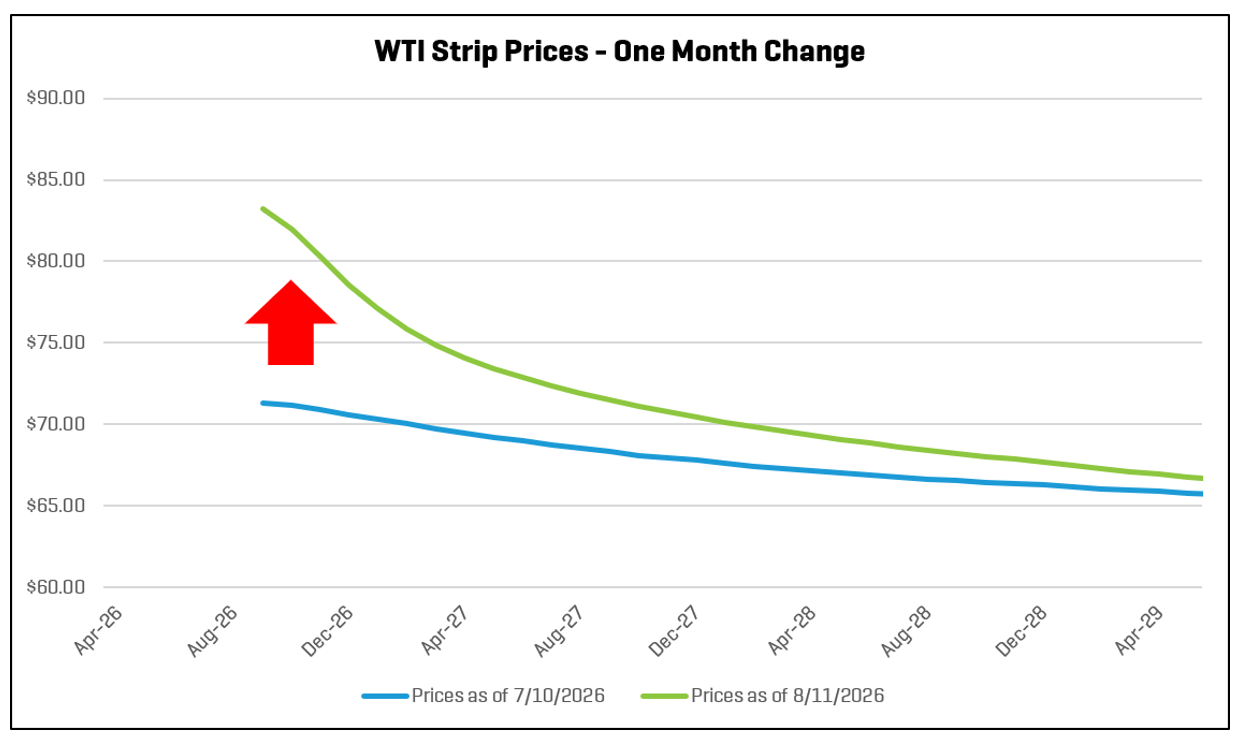
The curve remains in backwardation, indicating that the market expects future spot prices to be lower than near-term prices.
Oil Price Outlook
The price distribution below shows the crude oil spot price on August 12, 2026, together with predicted prices based on options and futures markets. Light blue lines represent outcomes within one standard deviation (1σ) of the mean; dark blue lines represent outcomes within two standard deviations (2σ).
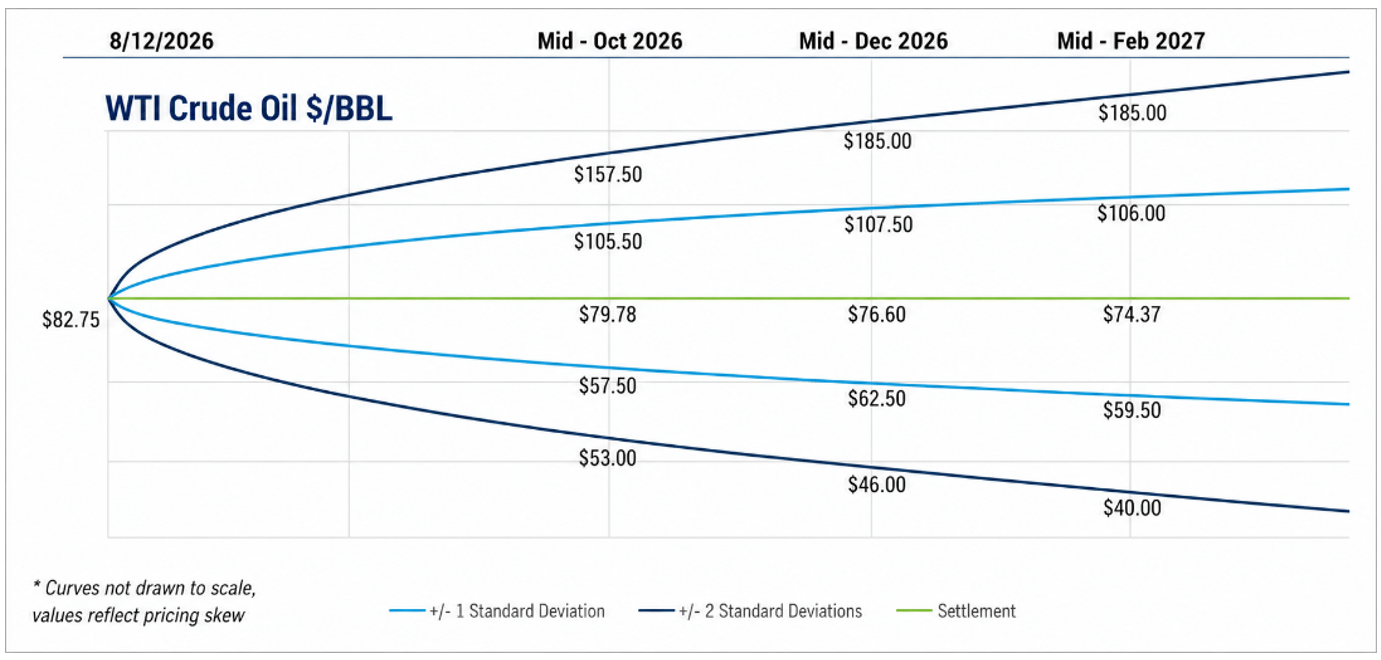
Based on these prices, the market indicated a 68% chance that oil would trade between $57.50 and $105.50 per barrel in mid-October 2026, between $62.50 and $107.50 per barrel in mid-December 2026, and between $59.50 and $106.00 per barrel in mid-February 2027. It also indicated a 95% chance of a range between $53.00 and $157.50 per barrel in mid-October 2026, between $46.00 and $185.00 per barrel in mid-December 2026, and between $40.00 and $185.00 per barrel in mid-February 2027.
Market Implications
Option prices and models reflect expected probabilities, not certain outcomes. They nevertheless remain useful tools for assessing market expectations and risk.
For mid-February 2027 pricing as of August 12, 2026, the 1σ range spanned $46.50 per barrel, while the 2σ range spanned $145.00 per barrel. Compared with the mid-January 2027 forecast from a month earlier, the near-term spread narrowed modestly while the tail-risk spread widened slightly, suggesting the market's core price expectations have tightened even as downside and upside risk remain elevated.
- “UAE to Double Oil Pipeline Capacity By 2027,” Institute for Energy Research, May 20, 2026.
- Salim A. Essaid, “UAE’s West-East pipeline expansion to become operational in 2027, doubling oil export capacity,” The National, May 15, 2026.
- “Strait of Hormuz,” International Energy Agency, February 2026.
- International Energy Agency, The Guardian, Institute for Energy Research, and SpeedCommerce.
- “Middle East War to Spark Biggest Energy Price Surge in Four Years,” World Bank Group, April 28, 2026.
- “Short-Term Energy Outlook,” U.S. Energy Information Administration, August 11, 2026.